Showing posts with label economy. Show all posts

Wednesday, August 11, 2010

Thriving in Today's Workplace


Kirsten Olson wrote an article last year titled New Learners for the New Economy. She tells college students and those who recently graduated, what habits and attitudes are crucial for thriving in the workplace.

Kirsten's essay is so relevant, that not only does it pertain to students, it pertains to business owners, managers and coworkers. And, if you substitute a few nouns, it pertains to Australian aborigines. Really. It's that relevant.

Kirsten asks her readers, "What learning attributes do employers seek in the flatter, fragmented, and constantly changing workplace?"

Most of us employers are so busy trying to run our businesses, we don't give much thought to what sort of learning attributes we should be seeking in prospective coworkers. Fortunately for us Kirsten did. She calls them habitudes (habits plus attitudes). Check them out:

New learners for the new economy...

1. Are highly adaptive.
2. Ask great questions.
3. Are curious about everything.
4. Have a broad knowledge base that they are always expanding.
5. Are good at seeing patterns.
6. Are team players who share what they know willingly and generously.
7. Are a glass-half-full resource managers.
8. Understand that every contact matters.
9. Know that hierarchy doesn't matter.
10. Are choiceful about how they socialize.
11. Own mistakes and are error alchemists.
12. See learning as a pleasure.

Kirsten expands on these habitudes in her article.
Kirsten Olson bio.
Wounded by School, Kirsten's book.

Wounded by School is an eye-opening journey into the world of the American school system today. A system that is inept in producing the attributes critical for today's business community and one that was around when Abraham Lincoln presided over our country. The book also offers ways to combat the wounds inflicted by school.

Sunday, July 11, 2010

To Win The War On Business: Advertise


This is my latest "Rant" in Contracting Business...

Private enterprise is under assault in America to a degree not seen since the Great Depression. While Hollywood and the media attack business with rhetoric, the government uses rhetoric, regulation, and taxes. It doesn't bode well for those struggling to find employment, though it might present an opportunity for your company.


Read more at Contracting Business (and be sure to add a comment in the new comment box at the bottom of the column).

Saturday, May 22, 2010

1099 Insanity

In a fit of legislative insanity, the massive health care bill that no one read included provisions for businesses to issue 1099s to other businesses whenever more than $600 in purchases is made in a calendar year.

According to an article on CNN/Money, “Starting in 2012, that changes. All business payments or purchases that exceed $600 in a calendar year will need to be accompanied by a 1099 filing. That means obtaining the taxpayer ID number of the individual or corporation you're making the payment to -- even if it's a giant retailer like Staples or Best Buy -- at the time of the transaction, or else facing IRS penalties.”

Wait. You gotta be kidding me, right?

The CNN article quoted Tom Henschke, president of SMC Business Councils, who said, "Just with business travel it would include hotels, rental cars. Phone service: 1099. Computer service: 1099. Whoever does your postage meter: 1099. You do a little advertising, Yellow Pages: 1099. Your landlord: 1099. You might as well just keep them in your pocket and hand them out as you go around every day."

It takes an average of 30 minutes to prepare a 1099. Small businesses file around 10 a year. Henschke’s group estimated the number of 1099s for the typical small business would jump to 200 for services purchased from corporations. The idiotic provision in the health care bill calls for the issuance of 1099s for the purchase of goods and services. How many 1099s is that? Will it double the number? Triple it?

Think about it. Buy a truck. Issue a 1099. Buy tools. Issue a 1099.  Buy almost anything for business and issue a 1099.

Brad Close of the National Federation of Independent Business was quoted in the National Review saying, “On average, small businesses spend more than $74 per hour on meeting their compliance obligations, which represents the most expensive paperwork burden that the federal government imposes on small-business owners.”

So each 1099 costs the company $37. Issuing ten 1099s per year costs $370. Let’s say the required number of 1099s creeps up to 500 when one is sent to every company a small business spends $600 with. At $37 each, this will cost the typical small business $18,500.

According to the Census, there were 27 million small businesses in 2004. At $18,500 per company, the cost of the 1099 paperwork to small business will be $500 billion. And this doesn’t include the need to track down the Federal Tax ID for every company receiving a 1099, correcting mistakes, etc.

Why do it? In the fantasy world of Congressional accounting, the bureaucrats and pols think it’s a revenue raiser. CNN reported that a government study “estimated that establishing additional 1099 paper trails for income could provide up to $345 billion annually in new federal tax revenues.”

This explains why it was stuffed into the health care legislation. It’s one of the accounting tricks the politicians used to offset the costs of the bill.

Let's be honest.  It’s a fantasy that the IRS is going to find $345 billion from requiring every small business to issue a 1099 to Best Buy for purchasing a budget laptop computer and basic software. In fact, I bet the processing expenses alone will cost more feds more than the marginal revenue generated from the provision's enactment. Even if the fantasy $345 billion is realized, it comes with over $500 billion of costs imposed on small business.

In truth, it's even worse for small business. To reduce the paperwork and tracking costs, expect companies to try and consolidate purchases, reducing the number of suppliers. Good news for big box stores.  Bad news for small retailers.

This is no way to run a railroad or a country. Having once been a consultant to the government’s railroad, I observed firsthand how poorly the Feds performed the former. It looks like they’re trying to flub up the latter too.

The lunacy of the law leads one to recall Ayn Rand...
“Did you really think we want those laws observed?” said Dr. Ferris. “We want them to be broken. You’d better get it straight that it’s not a bunch of boy scouts you’re up against... We’re after power and we mean it... There’s no way to rule innocent men. The only power any government has is the power to crack down on criminals. Well, when there aren’t enough criminals one makes them. One declares so many things to be a crime that it becomes impossible for men to live without breaking laws. Who wants a nation of law-abiding citizens? What’s there in that for anyone? But just pass the kind of laws that can neither be observed nor enforced or objectively interpreted – and you create a nation of law-breakers – and then you cash in on guilt. Now that’s the system, Mr. Reardon, that’s the game, and once you understand it, you’ll be much easier to deal with.”
Ayn Rand, Atlas Shrugged, 1957

Saturday, February 13, 2010

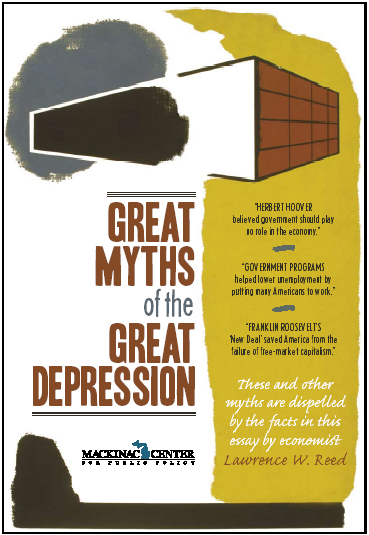
Economic Fundamentals: Great Myths of the Great Depression


Do you think we are in the midst of "unprecidented" times? Hardly. Consider the following...

Washington was rife with both fear and optimism as [the president] was sworn in…fear that the economy might not recover and optimism that the new and assertive president just might make a difference. [A humorist] captured the popular feeling toward [the president] as he assembled the new administration: “The whole country is with him, just so he does something. If he burned down the capitol, we would all cheer and say, well, we at least got a fire started anyhow.”

[The president] did indeed make a difference, though probably not the sort of difference for which the country had hoped. He started off on the wrong foot when, in his inaugural address, he blamed the [economy] on “unscrupulous money changers.” He said nothing about the role of the Fed’s mismanagement and little about the follies of congress that had contributed to the problem. As a result of his efforts, the economy would linger in [a downturn].

At Harvard University… [former Director of the Bureau and Budget, Lewis W.] Douglas made it plain that America was facing a momentous choice:

Will we choose to subject ourselves — this great country — to the despotism of bureaucracy, controlling our every act, destroying what equality we have attained, reducing us eventually to the condition of impoverished slaves of the state? Or will we cling to the liberties for which man has struggled for more than a thousand years? It is important to understand the magnitude of the issue before us. ... If we do not elect to have a tyrannical, oppressive bureaucracy controlling our lives, destroying progress, depressing the standard of living ... then should it not be the function of the Federal government under a democracy to limit its activities to those which a democracy may adequately deal, such for example as national defense, maintaining law and order, protecting life and property, preventing dishonesty, and ... guarding the public against ... vested special interests?

The above was written by economist Lawrence Reed for the Mackinac Center for Public Policy. Reed isn't referring to today, but to Franklin Roosevelt and the 1930s. These are the times that forged "The Greatest Generation" who later stormed the beaches at Normandy and Iwo Jima. Somehow they managed to survive the folly of Hoover and cynical machinations of Roosevelt, leaving behind an historical record we can study so we avoid similar errors.

Today, the government is making a mess of things, but it's not on the scale of Hoover/Roosevelt. Hoover signed Smoot Hawley, which all but killed international trade. Roosevelt's first budget called for Federal spending that was 333% greater than Federal revenues.

Hoover raised income taxes from 24% to 63%. Roosevelt further raised them to 79%, then 90%. After Congress balked at his attempt to levy a top marginal tax rate of 99.5%, Roosevelt issued an Executive Order to tax all income over $25,000 at 100% and to lower the personal exemption to a level where nearly everyone would get hammered by income tax! Fortunately, Congress intervened and rescinded the Executive Order.

The illogical John Maynard Keynes held sway over economic thought. The Federal Reserve was run by clueless, bumblers who contracted money supply when the economy contracted.

Even though the Roosevelt era has been whitewashed by historians from FDR's administration, the economic actions that characterized the Depression seem insane today. We are unlikely to repeat them because we have the benefit of past experience and more mediums to use to communicate that experience.

No doubt, there are individuals who believe they can make things turn out different. Fortunately, it's unlikely they will be given the time to do much damage.

Economists and historians have been reassessing the Great Depression of late and examining the economic policies of Hoover and Roosevelt. While not the conventional wisdom, Roosevelt has to be the worst president in our nation's history with Hoover close on his heels. They are much worse than the hapless Carter because Carter was, well, hapless.

For small business owners the lesson is that the current downturn will not last and it's unlikely that it will get worse. While it's not fun, we've endured much darker times and pushed through them. We will push through these.

We may not benefit from the same peacetime expansion that occured after Truman became president but we will, without doubt, experience a something akin to an economic boom in the future. Now is the time to position your company to take advantage of it.

If you are not already, market aggressively. Build your company's brand in your market. Take share from competitors who falter. Start revamping your management systems and controls so they will serve a much larger company. Ignore and avoid peers and the press preaching doom and gloom.  Stay positive and prepare for a wild ride!

To better understand the Depression, I strongly encourage you to download Reed's essay, Great Myths of the Great Depression (pdf). It's only 19 pages long and is very readable.

Wednesday, February 3, 2010

Contractors Expect Growth in 2010

The Service Roundtable Contractor Expectation Index is 79 for 2010, indicating a broad expectation of business expansion among the home service trades (an index above 50 reflects positive expectations). The index includes the outlook of air conditioning, electrical, and plumbing contractors in the residential service market.


Expectations are strongest among plumbing contractors at 84. Electrical contractors follow closely at 83. Air conditioning contractor expectations are 78. When contractors who were expecting a better year in 2010 were asked why they see improvement, the most common answer was an increase in marketing on the part of the contractor, particularly to existing customers.

Read the press release at the Service Roundtable.

Wednesday, January 20, 2010

Regime Uncertainty and the Massachusetts Election


Modern economic historians who study the Great Depression are beginning to focus on business uncertainty as a key reason the Great Depression was prolonged. Economic historian Robert Higgs makes the case in a paper, “Regime Uncertainty: Why the Great Depression Lasted So Long and Why Prosperity Resumed after the War (PDF).”

According to Higgs, “Businesspeople may be more or less ‘uncertain about the regime,’ by which I mean, distressed that investors’ private property rights in their capital and the income it yields will be attenuated further by government action. Such attenuations can arise from many sources, ranging from simple tax-rate increases to the imposition of new kinds of taxes to outright confiscation of private property. Many intermediate threats can arise from various sorts of regulation, for instance, of securities markets, labor markets, and product markets. In any event, the security of private property rights rests not so much on the letter of the law as on the character of the government that enforces, or threatens, presumptive rights.”

Higgs quotes economists and historians to support his points that uncertainty freezes investment, the Roosevelt administration created an environment of uncertainty, and business investment stagnated during the Depression.


How Uncertainty Affects Investment…

In an economy where entrepreneurship is decentralized, economic actors will hold back on long-term investments unless the state makes credible commitments to honor its contracts and respect individual ownership rights.

From the book, “Empirical studies in institutional change,” economists Lee J. Alston, Thráinn Eggertsson, and Douglass C. North


Investment spending on an aggregate level may be highly sensitive to risk in various forms…[including] uncertainty over future tax and regulatory policy… a major cost of political and economic instability may be its depressing effect on investment.

MIT Economist, Robert Pindyck


What does provide some degree of protection is the political system, together with the economic pressure groups that ensure that the state does not go ‘too far’ in interfering with the owner’s control over assets. This politically determined thin line may be understood as the real definition of property rights conferred by the state, as distinct from the somewhat fictitious legal notion of property rights. How broadly property rights are defined in this real sense and how effective states’ (largely nonlegal) commitment is to their security is a more serious problem than the issue of legal protections against the more traditional form of takings.

Columbia University Law Professor, Andrzej Rapaczynski


How Roosevelt Created Uncertainty…

[The Roosevelt administration] abruptly and dramatically altered the institutional framework within which private business decisions were made, not just once but several times with the result that regime uncertainty was heightened and recovery substantially retarded.

University of Iowa Economics Professor, Gene Smiley

What kind of uncertainty? Consider the following programs, cited by Higgs, that Roosevelt introduced:

1933
  • Agricultural Adjustment Act
  • National Industrial Recovery Act
  • Emergency Banking Relief Act
  • Banking Act of 1933
  • Federal Securities Act
  • Tennessee Valley Authority Act
  • Gold Repeal Joint Resolution
  • Farm Credit Act
  • Emergency Railroad Transport Act
  • Emergency Farm Mortgage Act
  • Home Owners Loan Corporation Act
1934
  • Securities Exchange Act
  • Gold Reserve Act
  • Communications Act
  • Railway Labor Act
1935
  • Bituminous Coal Stabilization Act
  • Connally (“hot oil”) Act
  • Revenue Act of 1935
  • National Labor Relations Act
  • Social Security Act
  • Public Utilities Holding Company Act
  • Banking Act of 1935
  • Emergency Relief Appropriations Act
  • Farm Mortgage Moratorium Act
1936
  • Soil Conservation & Domestic
  • Allotment Act
  • Federal Anti-Price Discrimination Act
  • Revenue Act of 1936
1937
  • Bituminous Coal Act Revenue Act of 1937
  • National Housing Act
  • Enabling (Miller-Tydings) Act
1938
  • Agricultural Adjustment Act
  • Fair Labor Standards Act
  • Civil Aeronautics Act
  • Food, Drug & Cosmetic Act
1939
  • Administrative Reorganization Act
1940
  • Investment Company Act Revenue Act of 1940
  • Second Revenue Act of 1940
Higgs wrote that, “Taken together, the many menacing New Deal measures, especially those from 1935 onward, gave businesspeople and investors good reason to fear that the market economy might not survive in anything like its traditional form and that even more drastic developments, perhaps even some kind of collectivist dictatorship, could not be ruled out entirely.” Roosevelt, according to Higgs, “expressed a hostility bordering on hatred for investors as a class.”
[Businessmen in the 1930s] are not only, but they feel threatened. They realize that they are on trial before judges who have the verdict in their pocket beforehand, that an increasing part of public opinion is impervious to their point of view, and that any particular indictment will, if successfully met, at once be replaced by another.
Harvard economist, Joseph Schumpeter

Uncertainty rules the tax situation [in the 1930s], the labor situation, the monetary situation, and practically every legal condition under which industry must operate. Are taxes to go higher, lower or stay where they are? We don’t know. Is labor to be union or nonunion?… Are we to have inflation or deflation, more government spending or less?… Are new restrictions to be placed on capital, new limits on profits?… It is impossible to even guess at the answers.
Industrialist Lammot du Pont

For the most part the New Deal relied on private investment to stimulate recovery yet its rhetoric precluded the private confidence to invest. [Roosevelt] lost patience with corporation leaders, and younger New Dealers came to the fore who shared his reluctance to make concessions to conservative business opinion.… The men around Roosevelt were now highly skeptical of the ability of business to act in the national interest.
Cambridge University History Professor, Anthony Badger

Business leaders sincerely believed that the government was in evil hands…and preparing the way for socialism, communism, or some other variety of anti-Americanism.
Former New York University Economics Chairman, Herman Krooss

The Impact of Roosevelt’s Policies…
The failure of the New Deal to bring about an adequate revival of private investment is the key to its failure to achieve a complete and self–sustaining recovery of output and employment.
Economist & Former Chairman of the Philadelphia Federal Reserve, Lester Chandler

Perhaps the New Deal’s greatest failure lay in its inability to generate the revival in private investment that would have led to greater output and more jobs.
University of Leicester History Professor, Peter Fearon

Higgs makes the argument that the regime uncertainty didn’t truly end until, “the death of Roosevelt and the succession of Harry S Truman and his administration completed the shift from a political regime investors perceived as full of uncertainty to one in which they felt much more confident about the security of their private property rights. Sufficiently sanguine for the first time since 1929, and finally freed from government restraints on private investment for civilian purposes, investors set in motion the postwar investment boom that powered the economy’s return to sustained prosperity notwithstanding the drastic reduction of federal government spending from its extraordinarily elevated wartime levels.” “The New Deal,” concludes Higgs, “prolonged the Great Depression by creating an extraordinarily high degree of regime uncertainty in the minds of investors.”


Regime Uncertainty in 2009

A similar, though milder form of regime uncertainty, characterized the United States in 2009. The government nationalized most of the automotive and financial sectors, shoved an increasingly unpopular health care bill through the House and Senate that threatens to nationalize another sixth of the economy, rammed cap & trade (i.e., cap & tax) legislation through the House, created a pay czar to dictate private sector compensation, intends to pass union friendly “card check” legislation, is allowing tax cuts to expire, which essentially means a tax hike, and generally spewed anti-business rhetoric more worthy of Hugo Chavez than the U.S. government.

Much of the uncertainty ended last night with the surprise election of Scott Brown in the Massachusetts special Senate election. Brown provides a critical 41st vote to block cloture and allow the minority to filibuster legislation in the Senate. More important than the vote is the message Brown’s surprisingly strong election sends to moderates. If the GOP can take a Massachusetts Senate seat by a five point margin (i.e., it wasn’t close), all moderates in more conservative areas should be concerned.

Moderates now fear the voters more than their party leadership. Since politicians tend to put their self-interest first, this reduces the risk of passage of significant legislation that will fundamentally alter the business environment. While the administration’s pursuit of Keynesian economic policies will likely hinder, rather than help a recovery, this is a headwind that can be overcome.

The United States has always attracted business investment from around the world for our political and economic stability, reliance on the rule of law, and property rights. With regime uncertainty reduced, expect investment to increase. The business climate just took a tick up.

Friday, November 20, 2009

Emerson CEO Speaks Out On The Economy


As a believer in free markets, I've been curious why Fortune 500 CEOs have largely been silent about some of the destructive economic policies currently being pursued. Finally, a CEO speaks out. Even better, he's an HVAC and plumbing CEO.

As reported in Supply House Times, Emerson Electric's CEO, David Farr, made some blunt statements at the Baird Industrial Outlook conference about the impact of cap & trade, socialized medicine, and anti-business labor laws...

  • Companies are creating jobs in China and India because they are "places where people want the products and where the governments welcome you to actually do something."

  • "My job is to grow that top line, grow my earnings, grow my cash flow and grow my returns to the shareholders. My job is not to shrink and roll over for the U.S. government."

  • "I’m not going to hire anybody in the United States. I’m moving."

This type of candor from the Fortune 500 is good news. I'm sure it's being said in private, but not so much in public. By speaking out, Farr is helping to highlight the consequences of foolish policies while there's an opportunity to prevent them.

Kudos to David Farr! We need more business leaders with Farr's gumption.

Read the article in Supply House Times.

Monday, October 12, 2009

News That Doesn't Depress You: Recovery May Be Stronger Than Forecast Says FedEx Economist


The Journal of Commerce Online reports that Gene Huang, the chief economist with FedEx, thinks the economy is in recovery and could easily hit 3% GDP growth next year. This exceeds the 2.4% consensus forecast. Based on Huang, Morgan Stanley analyst, William Greene advised investors that the concensus was "far too conservative."

While he believes the economy will exceed current expectations, Huang does worry that consumer angst may slow growth below the average recession recovery rate of 5.4%. Consumer recalcitrance may even lead to a "W" shaped recession. Counterbalancing that potential is the stock market's recovery, which to date has restored $4 trillion of household wealth.

Worried about the economy, consumers have increased the savings rate to 4%. This is resulting in $400 billion of increased household wealth each year. Thus, consumers have the wealth to spend. If they regain the confidence to spend, growth would be robust.

Whatever the initial cause(s), it appears that any continuation of the recession or economic anemia moving forward is a crisis of confidence more than cause.

Thursday, October 8, 2009

Surging Ahead In a Storm


One of Jeb Blount's recent Sales Gravy podcasts struck a nerve with me. It's the perfect description for using a weak economy to surge past your competition.

Blount described a pair of cars driving down a highway at a high rate of speed. One car is miles ahead of the other. The second car is driving a little faster and slowing closing the gap, but the distance is far enough and the first car is fast enough that it will take a long time to catch up and pass the leader.

Even so, it's uncertain the second car will pass the leader. The leader could accelerate. The second car's rate of speed could slow slightly. Thus the gap between the two may narrow, hold, or grow.

However, the tough economy, like a heavy storm, slows all cars. The leader, fearful of driving in these conditions, slows, and may even pull over and stop. This opens the possibility for the follower to surge ahead and pass the listless leader. When the storm passes, the former leader will have to regain momentum and play catch up. He may never catch up.

Today's economy is like driving in the storm. Many of your competitors are so afraid of hydroplaning and spinning out of control that they pull over and try to ride out the storm. This creates an opportunity for you. Take advantage of it!

Do not take your foot off the gas. Don't drive your company wildly, but don't slow down out of fear of what might happen. The economy is too resilient to stay down for long. Despite state and federal policy blunders (e.g., spending wildly on transfer payments rather than infrastructure investments, raising the minimum wage, increased trade restrictions, increased regulation, tax increases, flat out stupid energy policy, a climate of uncertainty, etc.), the economy is still growing.

No downturn is permanent. This one will not be an exception. While it may not feel like it, all economic signs point to a slow, gradual recovery. Remember, unemployment is a lagging indicator and will not start to fall until the recovery is well underway.

Now... right now... today is an opportunity to surge past your more fearful, conservative competitors. You may not encounter another economic climate as favorable as this one for aggressive individual company action for decades. Take advantage of it. Surge ahead!

Friday, September 11, 2009

News That Doesn't Depress You: Manufacturing Expands in August, Following 18 Consecutive Months of Contraction


The Institute of Supply Management's Purchasing Manager's Index (PMI) measures manufacturing expansion and contraction. When the PMI exceeds 50, the manufacturing sector is expanding. Less than 50 indicates a contraction. In August, the index was 52.9, the highest since June 2007.

Some industries are performing better than others. Industries that expanded include:

  • Textile Mills
  • Apparel, Leather & Allied Products
  • Paper Products
  • Miscellaneous Manufacturing
  • Printing & Related Support Activities
  • Computer & Electronic Products
  • Transportation Equipment
  • Nonmetallic Mineral Products
  • Electrical Equipment, Appliances & Components
  • Fabricated Metal Products
  • Chemical Products

Manufacturing industries still contracting include:

  • Primary Metals
  • Plastics & Rubber Products
  • Furniture & Related Products
  • Wood Products
  • Food, Beverage & Tobacco Products
  • Machinery

Representative comments from the survey respondents include:

  • "Production is picking up as demand [for] orders is being accelerated." (Nonmetallic Mineral Products)

  • "Demand from automotive manufacturers increasing thanks to 'Cash for Clunkers.'" (Fabricated Metal Products)

  • "In addition to improved business come the complications of a supply chain drained of inventory." (Paper Products)

  • "The sudden increase in customer demand, plus the low inventories held at services centers, is causing a shortage in the supply of raw steel." (Transportation Equipment)

  • "[It] appears customers' inventories are getting low, and they are cautiously placing orders." (Apparel, Leather & Allied Products)

CNBC's Larry Kudlow commented on the ISM report in his weekly editorial column:

At this pace, there could be 4 percent growth in real GDP for the third quarter.

Within the index, new business orders soared to 64.9 (the highest level since December 2004), production jumped to 61.9, and vendor performance improved to 57.1. This last statistic is important since vendor performance tracks supplier deliveries. When economic conditions heat up, deliveries tend to slow down. Think of Amazon delivering books a day or two later when orders are rapidly rising. And with inventories now at rock-bottom levels, businesses are going to have to rehire workers in order to reignite the production process and meet new demand.

Four percent growth is a lot lower than the 7 to 8 percent growth one would expect after a deep recession. That was the robust expansion pace we witnessed in 1983-84. But 4 percent growth becomes a V in light of pessimistic forecasts of 1 or 2 percent growth, or even a double-dip recession.

Kudlow credits the Fed's easy money and the market's ability to self-correct for economic mistakes as the reason we're emerging from the recession.

"While so-called spending-and-deficit stimulus may be an economic depressant, Friedmanite monetary stimulus -- which has been substantial -- is gradually exerting a powerful impact on economic growth," wrote Kudlow. "At the same time, businesses have become lean and mean, with radical cost-cutting of inventories, employment, and hours worked. That’s setting up a big profits surge, which is the biggest economic stimulus of all."

Kudlow is taking the Austrian economic view of the market, which makes him more bullish than Keynesian analysts currently holding sway on Wall Street. Kudlow notes that, "In Hayekian and von Misean terms, bad investment and spending decisions are being remedied through the free-market corrective process. And greased by easy money, today’s market correctives may produce a much stronger V-shaped recovery than the stock market consensus expects."

Wednesday, August 26, 2009

News That Doesn't Depress You: Housing Prices Rise In 18 Out Of 20 Markets


Every month, Wellesley economics professor Karl Case and Yale economics professor Robert Shiller, put together a housing price index based on the home prices in 20 metropolitan areas, with a two month lag. The June numbers for the Case-Shiller home price index were just released, revealing that prices improved in 18 of 20 markets!


Some highlights:

  • San Francisco - Up 3.8%

  • Boston - Up 2.6%

  • Cleveland - Up 4.2%

  • Phoenix - Up 1.1%


"A Big, Big Deal"

In the Spring economists expected housing prices to drop another 10%, resulting in more foreclosures, toxic assets, bank failures, etc. That's been averted.

The result, according to Dr Case, is that "banks will stabilize their balance sheets more quickly. The toxic paper will get written off more quickly. That’s a big, big deal."

Read More At The New York Times

Sunday, August 23, 2009

Economic Fundamentals: Government Stimulus Programs That Are Actually Working And Why


Arguably, the two most successful government programs to stimulate economic activity have been the notorious "Cash For Clunkers" program and the first time homebuyer tax credit.

The Cash For Clunkers program gave consumers a $4,500 credit towards a new car if they traded in an older vehicle with worse gas mileage. While it's idiocy along the lines of Roosevelt era farm policy that used tax money to pay farmers not to produce during a time of hungry people and high unemployment, it did prompt a reaction. According to a New York Times article, the program generated 457,000 sales in less than a month, prompting automakers to boost production and recall laid off workers.

The $8,000 tax credit for first time homebuyers is also working. Writing for the AP, Alan Zibel noted, "first-time buyers are snapping up one out of every three homes."

In other words, a large part of the housing rebound is directly related to the tax credit. When it ends, economists worry that the housing rebound will end with it.

In Zibel's article, he quoted economist Robert Dye, who said, "I would not be at all surprised to see a dip at the end of the year once the tax credit expires."

Cash For Clunkers used tax credits to encourage people to invest in new automobiles, and it works. The first time homebuyers program uses tax credits to encourage people to invest in new homes for the first time, and it works too!

Do you see the similarity? Both programs use tax credits to encourage investment. Both programs work.

And what does spending money do? "We have tried spending money," Treasury Secretary Henry Morgenthau wrote to his diary in 1939. "We are spending more than we have ever spent before and it does not work. . . . After eight years of this Administration we have just as much unemployment as when we started. . . . And an enormous debt to boot!" (Source)

If the government was serious about generating positive economic activity, all spending would be stripped from the stimulus bill, except for infrastructure and other capital investment spending. Instead of spending money and piling up debt, we would reduce marginal tax rates across the board, but especially corporate tax rates and capital gains to encourage investment. It works.

Saturday, August 22, 2009

News That Doesn't Depress You: Largest Monthly Home Sales Increase In 10 Years


Existing home sales continued to rebound with July posting the fourth straight monthly increase.

  • July sales increased 7.2%

  • Largest monthly increase in 10 years

  • Best sales month since August 2007

  • Distressed properties are down to roughly one third of sales (they were half)

  • Inventories of distressed properties are low in some of the markets hardest hit by the housing collapse


Read More

Thursday, August 13, 2009

News That Doesn't Depress You: Consumer Confidence Is Up


The following is from Rasmussen...

The Rasmussen Consumer Index, which measures the economic confidence of consumers on a daily basis, rose a tenth of a point on Thursday peaking yet again to its highest reading so far this year. At 80.0, the index is also at its highest level since September 17, 2008, just days after the Lehman Brothers collapse and the start of the financial crisis. Today's reading is up five points over the past week and up eight points over the past month. Consumer confidence is now up 20 points from the beginning of 2009.

The Rasmussen index had been trending down for some time. The chart below plots it from January 2008 through July 2009.


Click on the Chart For a Larger Image


The daily tracking poll (shown below) starting picking up in August as the media began reporting good news and the politicians realized that talking down the economy was impeding passage of favored legislation and thus, began exuding upbeat dialogue.


Click on the Chart For a Larger Image


The bottom line for you is that consumer confidence has returned to the same level it was before the financial meltdown. People are feeling better about things, though there's still caution. In this atmosphere, consumers will continue to seek value.

To encourage spending, continue to offer coupons, sales, and special promotions. In personal selling situations, stress the long term investment return from reduced energy expense, greater home valuations, and so on. While people ALWAYS want to indulge themselves, today they want a practical rationale underlying their indulgences. Present your products and services as smart moves and you will help consumers give themselves permission to buy what they want.

Sunday, August 9, 2009

Economic Fundamentals: Snoring Through Principles of Economics

This is just too funny not to post...

In every economics class, students are taught that when supply exceeds demand, prices must fall. They must.

To bad our current Treasury Secretary (possibly the worst in history, which is saying something considering his predecessor) must have slept through Econ 101.

As with all good humor, it's based on truth. Maybe Goldman alums are so used to manipulating big markets they think they can manipulate all markets, just because they say so.

The Daily Show With Jon StewartMon - Thurs 11p / 10c
Home Crisis Investigation
www.thedailyshow.com
Daily Show
Full Episodes
Political HumorSpinal Tap Performance


Fortunately, your success doesn't depend on the actions of the "capable" Geithner (and what do you expect Shiller to say, the truth?).

Monday, August 3, 2009

News That Doesn't Depress: Durable Goods Up, Consumer Spending Up


U.S. durable goods orders, excluding transportation, increased unexpectedly in May by 1.1%. In addition, consumer spending rose 0.3% in May.

Durable goods orders had been forecast by the Commerce Department to decline 0.4%. A Reuters survey of analysts projected a 0.6% decline. The 1.1% increase was a surprise. It follows revised data for April, where durable goods jumped 1.8%.

Moreover, machinery orders increased 7.7%, an indication that businesses are investing in factories. Non-defense capital goods orders, excluding aircraft, is considered to be a proxy for business spending. It rose 4.8% in May, after being forecast to fall 0.6%. We have to go back to September, 2004 to find a similar increase.

The government stimulus is finally starting to affect the economy as "social benefit payments" led to a 1.4% rise in personal incomes in May. After tax income rose 1.6% and disposable income increased 0.2%.

Spending only rose 0.3%, suggesting that consumers increased savings, and they did. The savings rate rose to 6.9%, the highest level in more than 15 years. Apparently, consumers are showing greater individual fiscal responsibility than the government.

Not all is good news. While existing home sales have increased, new single family home sales continued to slide, dropping 0.6% in May. However, signs do suggest the fall in home construction may be about turn. Median prices increased 4.2%, from $212,600 to $221,600. Demand for home loans increased.

So what does all of this mean? While no one's doing cartwheels over the data, it's stronger than expected. It does suggest we're at the bottom of the recession and things will start to slowly pick up.

For business owners, this is the time to aggressively grab market share. Your competitors will likely remain timid, resulting in less competition for your marketing and advertising messages. As the spending picks up, you'll get more than your current share.

Friday, July 31, 2009

Go Plumb Young Man


Job prospects are dim... except for the trades. The Manchester Union Leader reports that the New Hampshire Economic and Labor Market Information Bureau forecasts strong job growth for plumbers, pipefitters, roofers, cement masons, diesel mechanics, electricians, boilermakers, carpenters, and sheet metal workers for the next seven years. Accordingly, people who would have never considered the trades are attending trade school and signing up as apprentices.

"Plumbing probably wouldn't have crossed my mind if I had something lined up right out of college -- which five years ago was not uncommon," said 24 year old Nick Moreau.

Plumber Philip Cocchiaro delares, "You learn repair work, you'll always have food on the table."

"You've always got something you can fall back on," advises plumber, Bill Welcome. "You're always going to need a plumber, you're always going to need a mechanic for your car, and you're always going to need an electrician."

We've got a shortage of labor while college graduates have a shortage of jobs and an excess of debt. Maybe some should consider a trade before considering college. This a great time for contractors to approach high school guidance counselors to advise them about the prospects in our fields.

Download this FREE HVAC industry recruiting brochure from the Service Roundtable's Free Stuff page. Check out the other Free Stuff from the Service Roundtable.

Thursday, July 30, 2009

Economic Fundamentals: The Role of Incentives


“What gets rewarded gets done.”

That’s what business professor Michael LeBoeuf calls the greatest management principle.

Simple, isn’t it? Incentives work. It’s why the vast majority of sales professionals are paid partial to full commission. Every sales manager knows that a 100% salaried sales force is a lazy sales force.


Not Everyone Is Money Motivated

Of course, there are some people who are not money motivated. Incentives don’t work well for these individuals, even though managers try to impose them.

Some technicians, for example, fail to respond to contractor spiffs and incentives. All the tech has to do to earn extra money is offer homeowners a service agreement or place a few door hangers, but the tech resists.

What drives these guys? Some are craftsman who derive internal satisfaction from the quality of their work. Others are subject to the negative peer pressure of other technicians. Some receive enough money from wages and are not hungry enough to step outside of the comfort zone.

Creating incentives for employees who are not money motivated can be a challenge for owners and managers, in part because many managers do not understand people who will not respond to monetary incentives. If the manager is money motivated, he figures everyone else should be.

The challenge for the manager is to step outside his experience and find what the employee values and use that as a reward. It might be extra time off, flexibility on the job, a fishing or golf outing, and so on.


Money Motivated People Seek Incentives

So, we acknowledge that there are some people who are not money motivated while others are. While, people who are not money motivated gravitate towards occupations where incentives are not a factor in compensation, people who are money motivated tend to gravitate towards occupations where incentives exist, like sales.

For people who are incentive driven, the design of an incentive program is critical. Done well, it leads to greater exertion and effort. Salespeople, for example, sell more and earn more.

In some companies, superstar salespeople earn a lot. They may earn more than the boss and some bosses, especially bosses without sales experience, have a hard time handling it. They shouldn’t. When the salesperson makes more, the company makes more, and ultimately, the boss makes more.

Yet, ego sometimes trumps common sense and the boss decides to cap sales compensation. What a blunder!

“Caps have some considerable disadvantages,” writes Andris Zoltners, Prabhakant Sinha, and Sally Lorimer in The Complete Guide to Sales Force Incentive Compensation. “They can dampen the motivation of top performers. Salespeople stop working hard if they know they will not earn any incremental income from their efforts. Caps often encourage salespeople to hold sales over to the next period, when those sales can help them earn incremental income.”

I’m shocked, shocked that salespeople would hold sales over to the next period. I’m not, of course. Salespeople are especially prone to working the system to their advantage. Anyone who has sold or has managed salespeople should agree.

The mistake managers make capping sales income is no different than the mistake managers make when they insist on monetary incentives for employees not money motivated (or even negatively motivated due to negative peer pressure).


Three Truths About Sales Incentives

Here are three truths about incentive compensation for salespeople…

1. Since salespeople will work any compensation system to their advantage, it’s good management practice to keep the system simple and straightforward.

2. Since salespeople shut down when incentive compensation is curtailed or capped and this reduces company sales, salesperson earnings should be unlimited.

3. Since salespeople respond to incentive compensation, raising the commission tends to result in greater effort on the part of salespeople.


Tax Incentives

I ask why anyone should expect the tax code to work different as a disincentive?

By and large, high income earners are money motivated. They respond like salespeople. Increase the top marginal tax rate and they are less motivated to perform. They’ll spend their time working the system, looking for legal ways to avoid paying taxes. And given the inordinate complexity of the tax code, there are lots of ways to work the system. The net of this activity is efficient for the individuals, but not society.

If we want more economic activity as a society, we should reduce the disincentives (i.e., taxes), not increase them. This is all so blatantly obvious to me that I struggle to understand why everyone can’t see it. Then, I remember that the people who seek government jobs are not money motivated. If they were, they wouldn’t be in government. They don’t get it.

© 2009 Matt Michel

Wednesday, July 29, 2009

News That Doesn't Depress You: Economy Hitting Bottom Says Economist Alan Binder


Noted economist Alan Binder penned a piece for the Wall Street Journal where he argues that the economy has finally bottomed out and may even show surprising growth the remaining two quarters of the year.

Binder makes a fairly persuasive case, while acknowledging that job growth will be slow to return. "It will take years of strong growth to return to full employment," he writes.

The stock market's recent performance (i.e., the Dow crossed 9,000) is another indicator that things have bottomed. At the very least, the stock performance is a sign that the panic is over. People are no longer paralyzed, worrying about how bad it might get.

I found the national panic to be the most unsettling aspect of this recession and more than partly the result of irresponsible statements by our country's leaders. The panic made things much worse. If it has passed, it's a welcome sign that things may have indeed, bottomed out.

(c) 2009 Matt Michel

Tuesday, July 28, 2009

News That Doesn't Depress You: Home Sales Are Up


According to the National Association of Realtors(TM), existing home sales jumped a seasonally adjusted 3.6 percent in June. Moreover, the Mortgage Bankers Association reports that week-to-week loan applications are up 2.9 percent.

One reason for the increase is the jump in home affordability. Median prices are over 15 percent lower than a year ago.

The sales increase affects the entire country, led by Western states with a 6.4 percent June increased.

An uptick in housing bodes well for the entire economy.

Source