Showing posts with label economics. Show all posts

Sunday, July 11, 2010

To Win The War On Business: Advertise


This is my latest "Rant" in Contracting Business...

Private enterprise is under assault in America to a degree not seen since the Great Depression. While Hollywood and the media attack business with rhetoric, the government uses rhetoric, regulation, and taxes. It doesn't bode well for those struggling to find employment, though it might present an opportunity for your company.


Read more at Contracting Business (and be sure to add a comment in the new comment box at the bottom of the column).

Saturday, May 22, 2010

1099 Insanity

In a fit of legislative insanity, the massive health care bill that no one read included provisions for businesses to issue 1099s to other businesses whenever more than $600 in purchases is made in a calendar year.

According to an article on CNN/Money, “Starting in 2012, that changes. All business payments or purchases that exceed $600 in a calendar year will need to be accompanied by a 1099 filing. That means obtaining the taxpayer ID number of the individual or corporation you're making the payment to -- even if it's a giant retailer like Staples or Best Buy -- at the time of the transaction, or else facing IRS penalties.”

Wait. You gotta be kidding me, right?

The CNN article quoted Tom Henschke, president of SMC Business Councils, who said, "Just with business travel it would include hotels, rental cars. Phone service: 1099. Computer service: 1099. Whoever does your postage meter: 1099. You do a little advertising, Yellow Pages: 1099. Your landlord: 1099. You might as well just keep them in your pocket and hand them out as you go around every day."

It takes an average of 30 minutes to prepare a 1099. Small businesses file around 10 a year. Henschke’s group estimated the number of 1099s for the typical small business would jump to 200 for services purchased from corporations. The idiotic provision in the health care bill calls for the issuance of 1099s for the purchase of goods and services. How many 1099s is that? Will it double the number? Triple it?

Think about it. Buy a truck. Issue a 1099. Buy tools. Issue a 1099.  Buy almost anything for business and issue a 1099.

Brad Close of the National Federation of Independent Business was quoted in the National Review saying, “On average, small businesses spend more than $74 per hour on meeting their compliance obligations, which represents the most expensive paperwork burden that the federal government imposes on small-business owners.”

So each 1099 costs the company $37. Issuing ten 1099s per year costs $370. Let’s say the required number of 1099s creeps up to 500 when one is sent to every company a small business spends $600 with. At $37 each, this will cost the typical small business $18,500.

According to the Census, there were 27 million small businesses in 2004. At $18,500 per company, the cost of the 1099 paperwork to small business will be $500 billion. And this doesn’t include the need to track down the Federal Tax ID for every company receiving a 1099, correcting mistakes, etc.

Why do it? In the fantasy world of Congressional accounting, the bureaucrats and pols think it’s a revenue raiser. CNN reported that a government study “estimated that establishing additional 1099 paper trails for income could provide up to $345 billion annually in new federal tax revenues.”

This explains why it was stuffed into the health care legislation. It’s one of the accounting tricks the politicians used to offset the costs of the bill.

Let's be honest.  It’s a fantasy that the IRS is going to find $345 billion from requiring every small business to issue a 1099 to Best Buy for purchasing a budget laptop computer and basic software. In fact, I bet the processing expenses alone will cost more feds more than the marginal revenue generated from the provision's enactment. Even if the fantasy $345 billion is realized, it comes with over $500 billion of costs imposed on small business.

In truth, it's even worse for small business. To reduce the paperwork and tracking costs, expect companies to try and consolidate purchases, reducing the number of suppliers. Good news for big box stores.  Bad news for small retailers.

This is no way to run a railroad or a country. Having once been a consultant to the government’s railroad, I observed firsthand how poorly the Feds performed the former. It looks like they’re trying to flub up the latter too.

The lunacy of the law leads one to recall Ayn Rand...
“Did you really think we want those laws observed?” said Dr. Ferris. “We want them to be broken. You’d better get it straight that it’s not a bunch of boy scouts you’re up against... We’re after power and we mean it... There’s no way to rule innocent men. The only power any government has is the power to crack down on criminals. Well, when there aren’t enough criminals one makes them. One declares so many things to be a crime that it becomes impossible for men to live without breaking laws. Who wants a nation of law-abiding citizens? What’s there in that for anyone? But just pass the kind of laws that can neither be observed nor enforced or objectively interpreted – and you create a nation of law-breakers – and then you cash in on guilt. Now that’s the system, Mr. Reardon, that’s the game, and once you understand it, you’ll be much easier to deal with.”
Ayn Rand, Atlas Shrugged, 1957

Saturday, April 3, 2010

Economic Fundamentals: Barstool Economics


I didn't write this. I don't know who did. I grabbed it from Matthew Burke's Freedom Post blog. Burke tried to find the original author and couldn't find him. Whoever wrote it, it's the essence of economics in action. Read it and pass it along.

Suppose that every day, ten men go out for beer and the bill for all ten comes to $100. If they paid their bill the way we pay our taxes, it would go something like this:

  • The first four men (the poorest) would pay nothing.
  • The fifth would pay $1.
  • The sixth would pay $3.
  • The seventh would pay $7.
  • The eighth would pay $12.
  • The ninth would pay $18.
  • The tenth man (the richest) would pay $59.
So, that's what they decided to do. The ten men drank in the bar every day and seemed quite happy with the arrangement, until one day, the owner threw them a curve.
"Since you are all such good customers," he said, "I'm going to reduce the cost of your daily beer by $20."
Drinks for the ten now cost just $80. The group still wanted to pay their bill the way we pay our taxes so the first four men were unaffected. They would still drink for free. But what about the other six men - the paying customers? How could they divide the $20 windfall so that everyone would get his 'fair share?' They realized that $20 divided by six is $3.33. But if they subtracted that from everybody's share, then the fifth man and the sixth man would each end up being paid to drink his beer. So, the bar owner suggested that it would be fair to reduce each man's bill by roughly the same amount and he proceeded to work out the amounts each should pay. And so:
  • The fifth man, like the first four, now paid nothing (100% savings).
  • The sixth now paid $2 instead of $3 (33%savings).
  • The seventh now pay $5 instead of $7 (28%savings).
  • The eighth now paid $9 instead of $12 (25% savings).
  • The ninth now paid $14 instead of $18 (22% savings).
  • The tenth now paid $49 instead of $59 (16% savings).
Each of the six was better off than before. And the first four continued to drink for free. But once outside the restaurant, the men began to compare their savings.
"I only got a dollar out of the $20," declared the sixth man. He pointed to the tenth man," but he got $10!"
"Yeah, that's right," exclaimed the fifth man. "I only saved a dollar, too. It's unfair that he got ten times more than I!"
"That's true!!" shouted the seventh man. "Why should he get $10 back when I got only two? The wealthy get all the breaks!"
"Wait a minute," yelled the first four men in unison. "We didn't get anything at all. The system exploits the poor!"
The nine men surrounded the tenth and beat him up. The next night the tenth man didn't show up for drinks, so the nine sat down and had beers without him. But when it came time to pay the bill, they discovered something important. They didn't have enough money between all of them for even half of the bill!
And that, boys and girls, journalists and college professors, is how our tax system works. The people who pay the highest taxes get the most benefit from a tax reduction. Tax them too much, attack them for being wealthy, and they just may not show up anymore. In fact, they might start drinking overseas where the atmosphere is somewhat friendlier.
For those who understand, no explanation is needed. For those who do not understand, no explanation is possible.
Why does this matter? Our country is beginning to beat the snot out the tenth man in our society. If we allow it to continue, the result is inevitable.

Thursday, February 18, 2010

Contractors Expect Growth in 2010


The Service Roundtable Contractor Expectation Index is 79 for 2010, indicating a broad expectation of business expansion (an index above 50 reflects positive expectations). The index includes the outlook of air conditioning, electrical, and plumbing contractors in the residential service market.

Expectations are strongest among plumbing contractors at 84. Electrical contractors follow closely at 83. Air conditioning contractor expectations are 78. When contractors who were expecting a better year in 2010 were asked why they see improvement, the most common answer was an increase in marketing on the part of the contractor, particularly to existing customers.

“We have increased our marketing dollars by 75%,” commented one contractor.

“We are concentrating more on marketing to our existing customer base and some social networking and website,” added another.

Contractors also cited an improving economy, pent up demand from homeowners delaying major expenses, the last year of the tax credits, better training, and pure hustle.

“I think the consumer will be slowly starting to spend money they have been holding onto in the past 18+ months,” noted one contractor.

“I am investing $100,000 in sales training to ensure that we will be ahead this year,” commented one contractor.

“We are learning new ways to sell smarter,” summed up another, “and have been actively working on bringing in new customers and retaining our existing customers.”

Not all contractors are optimistic. Those believing 2010 will be flat or in decline cite the economy, a lack of credit, consumers deferring major expenses, and Washington policy.

According to one contractor the economy will be down due to the “lack of consumer ability to get financed on simple consumer loans. Customers are fixing up rather than replacing.”

“Our customers either don't have a job and money to spend,” noted one contractor, “or even if they do have a job, they are still not spending their money.”

Contractors are less optimistic about the next month. Nevertheless, most expect month-to-month improvement in February and better February performance compared to a year ago. While contractors in the plumbing, electric, and HVAC trades appear to believe that more momentum will be generated as the year progresses, HVAC contractors are generally more pessimistic about February due to industry seasonality.

“February is always slower than January (less demand calls, fewer leads, etc.),” commented one contractor.


Service Roundtable Contractor Expectation Index

TotalHVACPlumbingElectrical
2010 vs 200979788483
Feb ’10 vs Jan ‘1060596267
Feb ’10 vs Feb ‘0972707971

The index is based on survey responses of 191 Service Roundtable members during the last week of January 2010. The survey is calculated by taking the percentage of contractors expecting growth and adding half the percentage expecting no change. An index of 50 reflects expectations for flat growth, over 50 reflects expectations of expansion, and less than 50 reflects expectations of contraction.

The Service Roundtable is the world’s largest private contractor business alliance with members in the electrical, plumbing, and heating and air conditioning trades. Members come from all 50 states, Canada, Australia, Europe, the Caribbean, and South Seas Islands. For more information visit www.ServiceRoundtable.com or call 877.262.3341.

Wednesday, February 17, 2010

"Francisco's Money Speech"


There's been a resurgence of interest in Ayn Rand's classic book, Atlas Shrugged. This 50+ year old 1000+ page book suddenly jumped in 2009 to #95 on Amazon's list of bestsellers. Sue Grafton's book, U, only made #99.

I've written about Atlas before. While I don't agree with everything Rand advocates, I do think Atlas is one of several books she's written that everyone should read. Certainly every business owner should read Atlas.

Maybe 1000+ pages is more than you can take. At least read "Francisco's Money Speech," which is the response of one character in the book to a vapid woman's disdain toward business and the pursuit of profit...

"So you think that money is the root of all evil?" said Francisco d'Anconia. "Have you ever asked what is the root of money? Money is a tool of exchange, which can't exist unless there are goods produced and men able to produce them. Money is the material shape of the principle that men who wish to deal with one another must deal by trade and give value for value. Money is not the tool of the moochers, who claim your product by tears, or of the looters, who take it from you by force. Money is made possible only by the men who produce. Is this what you consider evil?
Read the rest at Capitalism Magazine. If you do, I bet you'll want to buy the book.

Saturday, February 13, 2010

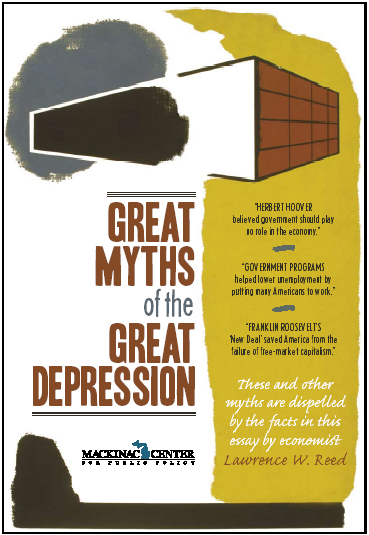
Economic Fundamentals: Great Myths of the Great Depression


Do you think we are in the midst of "unprecidented" times? Hardly. Consider the following...

Washington was rife with both fear and optimism as [the president] was sworn in…fear that the economy might not recover and optimism that the new and assertive president just might make a difference. [A humorist] captured the popular feeling toward [the president] as he assembled the new administration: “The whole country is with him, just so he does something. If he burned down the capitol, we would all cheer and say, well, we at least got a fire started anyhow.”

[The president] did indeed make a difference, though probably not the sort of difference for which the country had hoped. He started off on the wrong foot when, in his inaugural address, he blamed the [economy] on “unscrupulous money changers.” He said nothing about the role of the Fed’s mismanagement and little about the follies of congress that had contributed to the problem. As a result of his efforts, the economy would linger in [a downturn].

At Harvard University… [former Director of the Bureau and Budget, Lewis W.] Douglas made it plain that America was facing a momentous choice:

Will we choose to subject ourselves — this great country — to the despotism of bureaucracy, controlling our every act, destroying what equality we have attained, reducing us eventually to the condition of impoverished slaves of the state? Or will we cling to the liberties for which man has struggled for more than a thousand years? It is important to understand the magnitude of the issue before us. ... If we do not elect to have a tyrannical, oppressive bureaucracy controlling our lives, destroying progress, depressing the standard of living ... then should it not be the function of the Federal government under a democracy to limit its activities to those which a democracy may adequately deal, such for example as national defense, maintaining law and order, protecting life and property, preventing dishonesty, and ... guarding the public against ... vested special interests?

The above was written by economist Lawrence Reed for the Mackinac Center for Public Policy. Reed isn't referring to today, but to Franklin Roosevelt and the 1930s. These are the times that forged "The Greatest Generation" who later stormed the beaches at Normandy and Iwo Jima. Somehow they managed to survive the folly of Hoover and cynical machinations of Roosevelt, leaving behind an historical record we can study so we avoid similar errors.

Today, the government is making a mess of things, but it's not on the scale of Hoover/Roosevelt. Hoover signed Smoot Hawley, which all but killed international trade. Roosevelt's first budget called for Federal spending that was 333% greater than Federal revenues.

Hoover raised income taxes from 24% to 63%. Roosevelt further raised them to 79%, then 90%. After Congress balked at his attempt to levy a top marginal tax rate of 99.5%, Roosevelt issued an Executive Order to tax all income over $25,000 at 100% and to lower the personal exemption to a level where nearly everyone would get hammered by income tax! Fortunately, Congress intervened and rescinded the Executive Order.

The illogical John Maynard Keynes held sway over economic thought. The Federal Reserve was run by clueless, bumblers who contracted money supply when the economy contracted.

Even though the Roosevelt era has been whitewashed by historians from FDR's administration, the economic actions that characterized the Depression seem insane today. We are unlikely to repeat them because we have the benefit of past experience and more mediums to use to communicate that experience.

No doubt, there are individuals who believe they can make things turn out different. Fortunately, it's unlikely they will be given the time to do much damage.

Economists and historians have been reassessing the Great Depression of late and examining the economic policies of Hoover and Roosevelt. While not the conventional wisdom, Roosevelt has to be the worst president in our nation's history with Hoover close on his heels. They are much worse than the hapless Carter because Carter was, well, hapless.

For small business owners the lesson is that the current downturn will not last and it's unlikely that it will get worse. While it's not fun, we've endured much darker times and pushed through them. We will push through these.

We may not benefit from the same peacetime expansion that occured after Truman became president but we will, without doubt, experience a something akin to an economic boom in the future. Now is the time to position your company to take advantage of it.

If you are not already, market aggressively. Build your company's brand in your market. Take share from competitors who falter. Start revamping your management systems and controls so they will serve a much larger company. Ignore and avoid peers and the press preaching doom and gloom.  Stay positive and prepare for a wild ride!

To better understand the Depression, I strongly encourage you to download Reed's essay, Great Myths of the Great Depression (pdf). It's only 19 pages long and is very readable.

Wednesday, January 20, 2010

Economic Fundamentals: Crony Capitalism


It's a myth that business is opposed to government interference in the economy. It's not. Business leaders love government interference. They love regulations. They love tariffs. They love them as long as they benefit their companies and/or penalize their competitors.

There are business leaders who will always seek to win politically what they are unable to win in the free market. You can often spot them on television, providing cover for the politician who is introducing some new law that reduces liberty, weakens the free market, and provides a drag on the economy at large, but that helps the business leader's company.

The term for this behavior is "crony capitalism." It's hard to fault business leaders who try to game the system. They're simply choosing the easy path to maximize shareholder value. It's cheaper to buy politicians than to buy share in a free market.

It's up to principled politicians to resist the seductive embrace of the crony capitalist. Unfortunately, politicians too often serve their self-interest rather than the public interest. They distort the free market by tilting the playing field in the direction of a favored few.

As government increases in size and scope, its ability to influence business increases. Market competition takes a back seat to political connections.

Recently, John Stossel focused on crony capitalism. Watch the following videos...

Part 1


Part 2


Part 3


Part 4


Part 5


Part 6

Friday, November 20, 2009

Emerson CEO Speaks Out On The Economy


As a believer in free markets, I've been curious why Fortune 500 CEOs have largely been silent about some of the destructive economic policies currently being pursued. Finally, a CEO speaks out. Even better, he's an HVAC and plumbing CEO.

As reported in Supply House Times, Emerson Electric's CEO, David Farr, made some blunt statements at the Baird Industrial Outlook conference about the impact of cap & trade, socialized medicine, and anti-business labor laws...

  • Companies are creating jobs in China and India because they are "places where people want the products and where the governments welcome you to actually do something."

  • "My job is to grow that top line, grow my earnings, grow my cash flow and grow my returns to the shareholders. My job is not to shrink and roll over for the U.S. government."

  • "I’m not going to hire anybody in the United States. I’m moving."

This type of candor from the Fortune 500 is good news. I'm sure it's being said in private, but not so much in public. By speaking out, Farr is helping to highlight the consequences of foolish policies while there's an opportunity to prevent them.

Kudos to David Farr! We need more business leaders with Farr's gumption.

Read the article in Supply House Times.

Wednesday, November 11, 2009

Churchillian Proverbs


Winston Churchill overcame a childhood speech impediment to become one of the world’s great orators and writers. He was also a visionary, standing nearly alone in warnings about the rise of national socialism (i.e., Nazis). The combination of keen insight, the ability to turn a phrase, and a lengthy career as a writer and speaker resulted in lots of quotable material. Here are some of my favorite quotes from Churchill. Enjoy them. These are gems!


  1. Some people regard private enterprise as a predatory tiger to be shot. Others look on it as a cow they can milk. Not enough people see it as a healthy horse, pulling a sturdy wagon.

  2. Success consists of going from failure to failure without loss of enthusiasm.

  3. We shape our buildings; thereafter they shape us.

  4. Success is not final, failure is not fatal: it is the courage to continue that counts.

  5. Sure I am of this, that you have only to endure to conquer.

  6. The empires of the future are the empires of the mind.

  7. You have enemies? Good. That means you've stood up for something, sometime in your life.

  8. We contend that for a nation to tax itself into prosperity is like a man standing in a bucket and trying to lift himself up by the handle.

  9. Every day you may make progress. Every step may be fruitful. Yet there will stretch out before you an ever-lengthening, ever-ascending, ever-improving path. You know you will never get to the end of the journey. But this, so far from discouraging, only adds to the joy and glory of the climb.

  10. It's not enough that we do our best; sometimes we have to do what's required.

  11. The farther backward you can look, the farther forward you can see.

  12. The first quality that is needed is audacity.

  13. The inherent vice of capitalism is the unequal sharing of blessings; the inherent virtue of socialism is the equal sharing of miseries.

  14. The power of man has grown in every sphere, except over himself.

  15. The price of greatness is responsibility.

  16. The truth is incontrovertible, malice may attack it, ignorance may deride it, but in the end; there it is.

  17. There is no such thing as a good tax.

  18. A fanatic is one who can't change his mind and won't change the subject.

  19. A joke is a very serious thing.

  20. A lie gets halfway around the world before the truth has a chance to get its pants on.

  21. A pessimist sees the difficulty in every opportunity; an optimist sees the opportunity in every difficulty.

  22. All the great things are simple, and many can be expressed in a single word: freedom, justice, honor, duty, mercy, hope.

  23. An appeaser is one who feeds a crocodile, hoping it will eat him last.

  24. Attitude is a little thing that makes a big difference.

  25. Continuous effort - not strength or intelligence - is the key to unlocking our potential.

  26. Courage is what it takes to stand up and speak; courage is also what it takes to sit down and listen.

  27. Criticism may not be agreeable, but it is necessary. It fulfils the same function as pain in the human body. It calls attention to an unhealthy state of things.

  28. Difficulties mastered are opportunities won.

  29. Eating words has never given me indigestion.

  30. However beautiful the strategy, you should occasionally look at the results.

  31. We occasionally stumble over the truth but most of us pick ourselves up and hurry off as if nothing had happened.

  32. I am always ready to learn although I do not always like being taught.

  33. I am an optimist. It does not seem too much use being anything else.

  34. There is no such thing as public opinion. There is only published opinion.

  35. These are not dark days: these are great days - the greatest days our country has ever lived.

  36. If you are going through hell, keep going.

  37. Kites rise highest against the wind - not with it.

  38. No crime is so great as daring to excel.

  39. No idea is so outlandish that it should not be considered with a searching but at the same time a steady eye.

  40. One ought never to turn one's back on a threatened danger and try to run away from it. If you do that, you will double the danger. But if you meet it promptly and without flinching, you will reduce the danger by half. Never run away from anything. Never!

  41. Play the game for more than you can afford to lose... only then will you learn the game.

  42. Socialism is a philosophy of failure, the creed of ignorance, and the gospel of envy, its inherent virtue is the equal sharing of misery.

  43. This is no time for ease and comfort. It is time to dare and endure.

  44. To build may have to be the slow and laborious task of years. To destroy can be the thoughtless act of a single day.

  45. True genius resides in the capacity for evaluation of uncertain, hazardous, and conflicting information.

  46. We are masters of the unsaid words, but slaves of those we let slip out.

  47. We make a living by what we get, but we make a life by what we give.

Friday, November 6, 2009

Economic Fundamentals: The Forgotten Depression


Have you ever heard of the other Depression of the 1920s? Sure, you've heard of the Great Depression that started under Hoover in 1929. But have you heard about the one that started under Wilson in 1921?


The Depression of 1920/21

The 1929 depression was characterized by double digit unemployment. The 1920/21 depression was also characterized by double digit unemployment. According to historian Burt Folsom, the 1920/21 meltdown "had economists excited over what was shaping up to be one of the worst crises in American history."

Come again?

Folsom says the end of the Wilson administration was characterized by massive unemployment as troops returned from the Great War (World War I). In 1918, the armed forces employed 2.9 million. By 1920, 320 thousand were in the armed forces. Unemployment reached 12% and was a huge issue in the presidential election.

Mismanagement at the Federal Reserve compounded problems. The Fed raised interest rates from 4% at the end of 1919 to 7% six months later. This choked off credit needed by businesses and consumers at a time when the labor force was swelling with returning veterans.

The economy contracted 6.9%, technically making the contraction a sharp recession and not a depression (a 10% contraction is necessary for a depression). Prices fell by 18% in a single year. Wholesale prices feel by 37%. Automobile production dropped 60%. Overall industrial production fell by 30%.

Technically, 1920/21 may not have been a depression, but it felt like one. Between the end of 1919 and the middle of 1921, the Dow fell 47%. The rate of business failures tripled and solvent businesses experienced a 75% decline in profitability.

Promising a "return to normalcy," Warren G. Harding was swept into office by a 60% to 34% landslide with Calvin Coolidge as his vice president. Half way through his term, Harding died from a heart attack and Coolidge was sworn in as president. Coolidge, one of the country's greatest and most overlooked presidents, continued Harding's economic policies seamlessly.

Harding's Secretary of Commerce was Herbert Hoover. Hoover pushed Harding to "do something." So Harding held a President's Conference on Unemployment. All of the brightest minds of industry, academia, and government were involved. Collectively, they urged Harding to engage in a massive stimulus program, putting unemployed vets to work on infrastructure projects, such as roads and bridges.
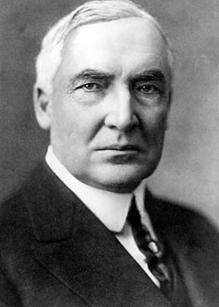

Warren Harding Cut Taxes and Spending

Harding's response? He said the spending would require massive tax increases that would cripple the economy. Instead, Harding did the opposite. He cut taxes and spending, which Coolidge continued after Harding's death.

Harding cut the top income tax rate from 73% to 25%. With better after tax returns, entrepreneurs were willing to risk their capital. If an entrepreneur risked and lost, he lost it all. If he risked and won with a 73% marginal rate, he could only keep 27% of his profit. When the rate lowered to 25%, he could keep 75%. Suddenly, more people were willing to take a chance.

Someone who wasn't taking much of a chance was Harding. As Treasury Secretary, Andrew Mellon said, "Seventy-three percent of nothing is nothing. Twenty-five percent of something is something."
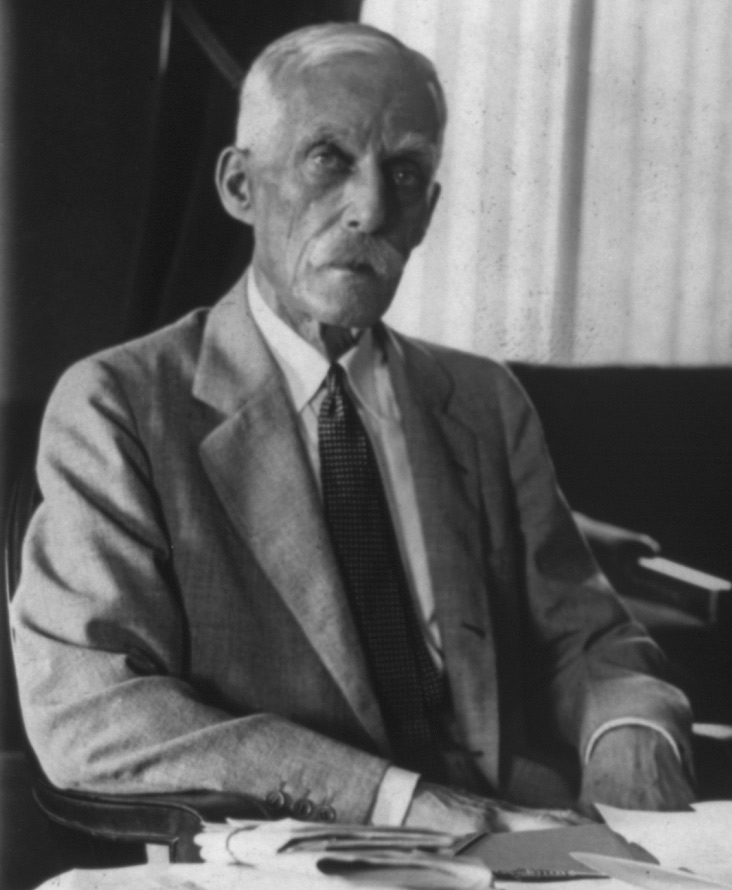

Was Andrew Mellon The Original Supply Sider?

Harding coupled the tax rate reductions with cuts in federal spending. Folsom reports that Harding wanted to keep the U.S. competitive globally and attract investment.

If you think that cutting government spending and tax rates is a recipe for massive deficits, guess again. The economy boomed as entrepreneurial activity was released. Overall tax receipts went from $700 million in 20/21 to over $1 billion by 28/29. The government ran surpluses, cutting 1/3rd of the national debt.


The Best Economic Performance of Any President Was Calvin Coolidge's

During Coolidge's term as president, unemployment averaged 3.3%. According to Folsom, at the end of his presidency, unemployment was 1%. Since inflation was 1%, Coolidge averaged a misery index (inflation + unemployment) of 4.3%, which half any other 20th century president.


The Great Depression

The 1920s depression you've probably heard about is the one that commenced under Hoover and was continued under Roosevelt. Hoover, if you recall, was one of the people who wanted to enact a stimulus program during the earlier depression. In private, Coolidge called Hoover, "wonder boy" and once remarked that, "He's been giving me advice for six years, all of it bad."

In school I learned that the Great Depression was started by the 1929 market crash, which was a failure of capitalism and free markets. The mythology is that Hoover did nothing. He sat back in callous disregard for the plight of the public. If only.


Herbert Hoover Was NOT an Advocate of the Free Market

In reality, the Depression didn't start with the stock market crash. In fact, the markets had started to recover. From mid November, 1929 to April, the Dow recouped half the decline from the peak and was nearly level with the prior year.


The Markets Were Rebounding From The Crash

Milton Friedman, the greatest economist of the 20th century, advanced the belief that the Fed's contraction of the money supply (and increase in rates) kick started the Great Depression. Others blame the Smoot-Hawley tariff. Still others, credit a combination.
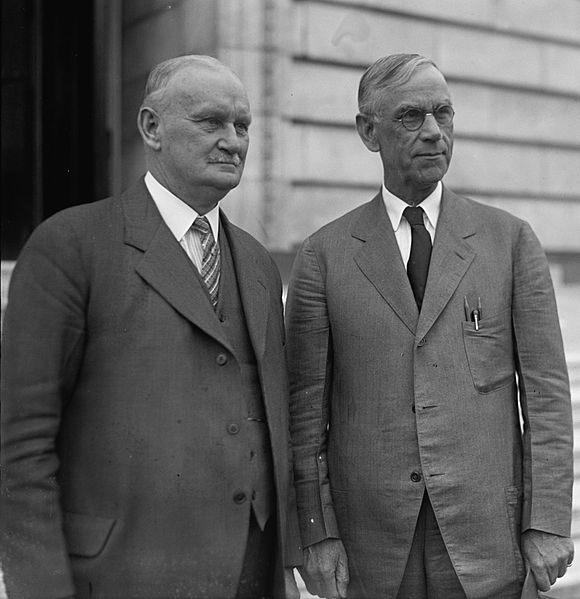

Smoot & Hawley May Have Drafted The Most
Economically Damaging Piece of Legislation In History
(Though Congress Keeps Trying To Get One Worse)

Smoot-Hawley was the largest tariff increase in U.S. history. The merits of free trade is one area with almost no disagreement among economists. Over 1,000 economists sent Hoover a petition urging a veto. Industrialist pleaded with him personally to veto the bill.

Hoover didn't listen. He signed Smoot-Hawley into law, raising tariffs on over 20,000 products, launching retaliatory tariffs around the world. The bill artificially raised prices on products made more competitively overseas. This led other countries to artificially raise the price of products we produced more competitively, killing our exports. Exports fell 27% in 1930, 36% in 1931, and 34% in 1932 (Source).

Next, Hoover launched his infrastructure stimulus program. To pay for it, he raised top marginal income tax rates from 25% to 63%. Unemployment soared to 25% in 1932.


Roosevelt Campaigned On Tax & Spending Cuts... Then, Reneged

Roosevelt entered the picture promising tax cuts and federal spending cuts. The party platform called for spending cuts of 25%. If Roosevelt would have kept his promises, the depression might have soon ended. He didn't and it didn't.

Roosevelt didn't like or trust entrepreneurs (the feeling was mutual). Rather than turn to business people for solutions to the economic problems Roosevelt assembled a "brain trust" of college professors. Yikes!

Folsom described the academic solutions. Farm exports were down, resulting in surplus production, and falling prices. The brain trust's solution? Pay farmers not to produce.

The farmers thought getting paid not to produce was a fine idea, but actually idling good farmland seemed kind of silly. So they cheated.

To stop the cheating, the government hired inspectors to physically check on the farms. So the farmers bribed the inspectors and kept on cheating.

In response, the government hired inspectors to check on the inspectors. When this didn't work because the inspectors split the bribes, aerial photography was deployed with auditors studying aerial photographs.

The Feds were determined and eventually, the U.S. did develop farm shortages. By 1935 we were importing cotton, corn, and wheat because farmers weren't producing enough. Some of the shortfall was due to the 1930's era global warming and the Dust Bowl. Still, it was absolutely ludicrous that we were paying farmers not to farm, importing farm products at a premium, and paying a legion of bureaucrats to oversee the entire mess. As Folsom says, this was only one government program and not even the worst.


The Dust Bowl: 1930s Era Global Warming

We had government sponsored price fixing. Business owners were told what they should charge and literally tossed in jail if they didn't charge enough.

Roosevelt started massive government programs left and right. New regulations and taxes arose in a kind of government schizophrenia that froze business investment out of uncertainty. We saw the creation of gas taxes, tire taxes, telephone taxes, telegram taxes, movie ticket taxes, and on and on.

Roosevelt boosted income tax rates to 79%. Later he even tried to hike the top marginal rate to 99.5%. When Congress resisted, he issued an executive order instituting a 100% income tax on all income over $25,000. Congress repealed this to 90%, which stayed in place until the Kennedy tax cuts in the early 1960s.
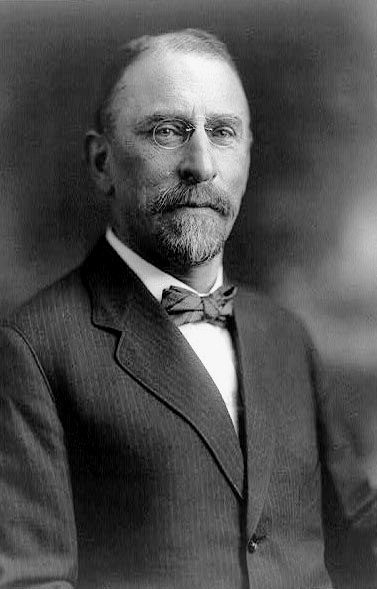

Henry Morenthau Admits The New Deal Failed

The tax and spend stimulus worked so well that U.S. unemployment was still at 19% in 1938, compared to 11% for the rest of the world. The Secretary of the Treasury, Henry Morgenthau, declared privately, "We have tried spending. We are spending more than we ever spent before and it does not work. We have never made good on our promises. I say that after eight years of this administration we have just as much unemployment as when we started and an enormous debt to boot."

The 1920s had two depressions. Harding and Coolidge fought one with low taxes and reduced spending to create an environment ripe for entrpreneurial stimulus. The result was a rapid end to the depression and one of the most prosperous decades in history. Harding and Coolidge were so successful that we don't even remember the depression they confronted.

The second depression was addressed by higher taxes across the board, massive government stimulus, tremendous government debt, and increased regulation that created an environment of uncertainty and froze entrepreneurial activity. Hoover and Roosevelt deepened and expanded the 1929 depression, turning it into the Great Depression.

Listen to the following address to a group of college students by Burt Folsom, where he compares and contrasts the economic policies and outcomes of Harding/Coolidge with Hoover/Roosevelt.


Why We Won't Repeat the Hoover/Roosevelt Experience

The comparisons between today and the Great Depression are eerie. The increased taxes, increased regulations, and protectionist trade measures are especially concerning. The business climate is clouded with uncertainty about government policies. However, it is unlikely that we will repeat the dismal performance of the 1930s for the following reasons...

1. Experience
In the 1930s, we had not experienced full blown Keynesian economics. Today, we have. Moreover, we've had the counter experience of the Kennedy Tax Cuts and Reagan Tax Cuts (not to mention, Harding's). We've felt the impact of Keynesian policies during the Nixon and Carter administrations. We've seen the impact on Japan with their "Lost Decade." While there are still committed Keynesians, they can no longer tout theory without opposition and without ignoring facts and history (though most will try).

2. Entrepreneurial Velocity
The world moves faster today than the 1930s. Businesses and entrepeneurs are simply faster than the slow, heavy hand of government. Think of a river, flowing in its channel. While it's possible to stop the flow by erecting a dam, the river will eventually overflow the dam unless released through a spillway.

The economic dams of government are eventually breached as the Soviet and Chinese experiences revealed. And in the U.S., the government isn't damming up the entrepreneurial river. It's merely tossing large boulders in the path of the river, which flows around or over the obstructions.

3. Information
During the Great Depression, information flow was centralized and limited to newspaper and radio. Roosevelt had an easy time using the bully pulpit of the presidency to dominate the information flow of the airwaves and used the power of the IRS to intimidate the press. Today, traditional media has become curiously incurious and monolithic. It's also rapidly becoming irrelevant as information is decentralized.

4. Taxes
It's simply impossible to imagine any politician advocating and the public accepting the confiscatory tax policies of the Roosevelt era. People forget that the top marginal rate was 90% in 1963! Kennedy brought it down to 70%, where it largely remained until Reagan. While Congress and the administration will foolishly allow the Bush tax cuts to expire next year, there's no returning to the high taxes of the past.


Top Marginal Rates

One area of concern is corporate taxes. Only stagnant Japan has higher corporate tax rates. Add state taxes and the U.S. has the world's least competitive corporate tax rates. High rates drive business and investment to countries offering higher after tax returns. As a nation, we need to get corporate taxes in line with the rest of the world.

Another concern is the recent discussion about a Value-Added Tax (VAT), unless it replaces the income tax. VATs are consumption taxes like the sales tax, only built into pricing and hidden from view. Based on the European experience, VATs tend to ratchet up whenever politicians are forced to prioritize. Carbon taxes, by the way, are also consumption taxes that are hidden from view.

5. The American Public
The populace is better educated and informed today. It is unlikely the public would allow government officials to tinker with their lives over a protracted period like the 1930s. Patience is thin and the voters are likely to return the country to divided government if the economy stagnates.

6. American Entrepeneurs
Personally, I have too much faith in American entrepreneurial ability and all levels. Despite attacks on business and the denigration of profitability by the media, government, and academia, the U.S. remains an entrepreneurial bastion. People are too creative, too resiliant, and too self-reliant to be suppressed. We will succeed in spite of government interference.

Still, imagine what would have happened if the TARP and stimulus funds had been passed along to the public in the form of reduced income, capital gains, and corporate taxes. I have to believe the recession would have ended in a heartbeat and we would be approaching full employment instead of cresting double digit unemployment.

As individuals, we can't control the government and should not let it control us. While it's up to each of us to be vigilant and to influence the governing class the best we can, we cannot forget that we control our own destinies. It is up to each of us to take all necessary steps to chart our own courses. History proves that we can succeed.

During the Great Depression, many companies prospered. They were the companies who acted as though there was no contraction. They aggressively sought new business and took it from their more timid competitors. Advertising executive, Dave Chase, describes what happened:

Generally speaking, those companies that not only survived but also thrived during the Great Depression were those that continued to act as though there were nothing wrong and that the public had money to spend. In other words, they advertised. These are industries that didn't wait for public demand for their products to rise. They created that demand even during the most difficult of times.

Because so many companies cut spending during the Great Depression era, advertising budgets were largely eliminated in many industries. Not only did spending decline, but some companies actually dropped out of public sight because of short-sighted decisions made about spending money to keep a high profile. Advertising cutbacks caused many customers to feel abandoned. They associated the brands that cut back on advertising with a lack of staying power. This not only drove customers to more aggressive competitors, but it also caused financial mistrust when it came to making additional investments in the no-longer-visible companies.

Both anecdotal and empirical evidence support the case that advertising was the main factor in the growth or downfall of companies during the Great Depression. To put it bluntly, the companies that demonstrated the most growth and that rang up the most sales were those that advertised heavily.

During every recessions many prosperous new businesses are created as well. Hyatt, Burger King, IHOP, the Jim Henson Company, LexisNexis, FedEx, Microsoft, CNN, MTV, Trader Joe's, Wikipedia, Sports Illustrated, and GE were all started during recessions (source). These companies started with no revenue during bad times and still prospered.

History has much to teach us if we'll study it. It shows that the American entreprenurial spirit is overwhelmingly powerful when supported and remains impossible to suppress when not supported. Don't let anyone suppress your spirit. Get out there and make something happen!

Monday, October 12, 2009

News That Doesn't Depress You: Recovery May Be Stronger Than Forecast Says FedEx Economist


The Journal of Commerce Online reports that Gene Huang, the chief economist with FedEx, thinks the economy is in recovery and could easily hit 3% GDP growth next year. This exceeds the 2.4% consensus forecast. Based on Huang, Morgan Stanley analyst, William Greene advised investors that the concensus was "far too conservative."

While he believes the economy will exceed current expectations, Huang does worry that consumer angst may slow growth below the average recession recovery rate of 5.4%. Consumer recalcitrance may even lead to a "W" shaped recession. Counterbalancing that potential is the stock market's recovery, which to date has restored $4 trillion of household wealth.

Worried about the economy, consumers have increased the savings rate to 4%. This is resulting in $400 billion of increased household wealth each year. Thus, consumers have the wealth to spend. If they regain the confidence to spend, growth would be robust.

Whatever the initial cause(s), it appears that any continuation of the recession or economic anemia moving forward is a crisis of confidence more than cause.

Saturday, October 3, 2009

Economic Fundamentals: Revisiting The New Deal


Franklin Roosevelt has been lionized by historians who lived through the New Deal, notably Arthur Schlesinger, Jr. Many of the historians with memories of the New Deal have passed from the scene. Now, a new generation of historians and economists are taking a dispassionate look at Roosevelt's policies.

In terms of pure economics, many of today's historians and economists are coming to different conclusions about Roosevelt. While he was preceded by the disasterous policies of Hoover (a true incompetent), his own policies not only failed to end the Great Depression, but extended and deepened it.

Burt Folsom is one of the historians who is reassessing Roosevelt's policies. Recently, he wrote a book about Roosevelt's economic policies called, "New Deal or Raw Deal?" For an academic, Folsom is highly entertaining. The following videos about his book are from a lecture that appeared on C-SPAN."


In time, I believe Roosevelt will be reassessed as one of the worst presidents in history based on his economic policies.

Friday, September 11, 2009

News That Doesn't Depress You: Manufacturing Expands in August, Following 18 Consecutive Months of Contraction


The Institute of Supply Management's Purchasing Manager's Index (PMI) measures manufacturing expansion and contraction. When the PMI exceeds 50, the manufacturing sector is expanding. Less than 50 indicates a contraction. In August, the index was 52.9, the highest since June 2007.

Some industries are performing better than others. Industries that expanded include:

  • Textile Mills
  • Apparel, Leather & Allied Products
  • Paper Products
  • Miscellaneous Manufacturing
  • Printing & Related Support Activities
  • Computer & Electronic Products
  • Transportation Equipment
  • Nonmetallic Mineral Products
  • Electrical Equipment, Appliances & Components
  • Fabricated Metal Products
  • Chemical Products

Manufacturing industries still contracting include:

  • Primary Metals
  • Plastics & Rubber Products
  • Furniture & Related Products
  • Wood Products
  • Food, Beverage & Tobacco Products
  • Machinery

Representative comments from the survey respondents include:

  • "Production is picking up as demand [for] orders is being accelerated." (Nonmetallic Mineral Products)

  • "Demand from automotive manufacturers increasing thanks to 'Cash for Clunkers.'" (Fabricated Metal Products)

  • "In addition to improved business come the complications of a supply chain drained of inventory." (Paper Products)

  • "The sudden increase in customer demand, plus the low inventories held at services centers, is causing a shortage in the supply of raw steel." (Transportation Equipment)

  • "[It] appears customers' inventories are getting low, and they are cautiously placing orders." (Apparel, Leather & Allied Products)

CNBC's Larry Kudlow commented on the ISM report in his weekly editorial column:

At this pace, there could be 4 percent growth in real GDP for the third quarter.

Within the index, new business orders soared to 64.9 (the highest level since December 2004), production jumped to 61.9, and vendor performance improved to 57.1. This last statistic is important since vendor performance tracks supplier deliveries. When economic conditions heat up, deliveries tend to slow down. Think of Amazon delivering books a day or two later when orders are rapidly rising. And with inventories now at rock-bottom levels, businesses are going to have to rehire workers in order to reignite the production process and meet new demand.

Four percent growth is a lot lower than the 7 to 8 percent growth one would expect after a deep recession. That was the robust expansion pace we witnessed in 1983-84. But 4 percent growth becomes a V in light of pessimistic forecasts of 1 or 2 percent growth, or even a double-dip recession.

Kudlow credits the Fed's easy money and the market's ability to self-correct for economic mistakes as the reason we're emerging from the recession.

"While so-called spending-and-deficit stimulus may be an economic depressant, Friedmanite monetary stimulus -- which has been substantial -- is gradually exerting a powerful impact on economic growth," wrote Kudlow. "At the same time, businesses have become lean and mean, with radical cost-cutting of inventories, employment, and hours worked. That’s setting up a big profits surge, which is the biggest economic stimulus of all."

Kudlow is taking the Austrian economic view of the market, which makes him more bullish than Keynesian analysts currently holding sway on Wall Street. Kudlow notes that, "In Hayekian and von Misean terms, bad investment and spending decisions are being remedied through the free-market corrective process. And greased by easy money, today’s market correctives may produce a much stronger V-shaped recovery than the stock market consensus expects."

Tuesday, September 8, 2009

Defending Capitalism


I can't recall a time when capitalism was under assault like today. The closest was when Nixon declared himself a Keynesian, instituted wage and price controls, responded to the OPEC oil price shock by rationing gas, launched affirmative action, and created the EPA, OSHA, and the EEOC. Yet, even during the days of Nixonian economic meddling almost everyone at least paid lip service to notion that capitalism was superior to socialism and communism (which are really just different shades of the same color). And this was before the Soviet Union collapsed and communism was spreading triumphantly in Africa, Asia, and Latin America.

Today, we can see the wreck socialism and communism has made of countries around the world. As Churchill said, "Socialism is a philosophy of failure, the creed of ignorance, and the gospel of envy, its inherent virtue is the equal sharing of misery."

History shows socialism is a failure and capitalism is a success. Yet, collectively, we're not paying attention to the lessons of the last century. More and more people fail to see socialism and communism as rusty failures, believing instead that they are bright, shiny, beautiful new economic philosophies that are much more alluring than crass, crude capitalism.

It's now chic to wear t-shirts featuring the murderous thug Che Guevara. Newsweek proudly declares in a cover story, "We are all socialists now!" Oliver Stone makes loving documentaries about Castro and Chavez. Michael Moore, the living definition of hypocrisy, releases another propaganda piece where the leftist loon calls capitalism evil and declares that it must be replaced (though Moore's not offering to share his eight figure net worth).

Lots of people are throwing rocks at capitalism. Few defend it these days, which is dangerous. Out of ignorance, the public might just chunk it for socialism. According to a Rasmussen poll, one American in five prefers socialism to capitalism and another 27% aren't sure which system is better. Among adults under age 30, a third prefer socialism and another 30% aren't sure which is the better system. This is truly frightening.

Despite the presence of Ted Turner, one of the best defenses of capitalism, the pursuit of individual self interest, and the profit motive was the John Stossel special on greed. Stossel has been trying to get this shown in schools. After watching it, you might want to show it to your kids. It's in three parts and takes around 40 minutes.

Part 1


Part 2


Part 3

Sunday, September 6, 2009

Sunday, August 23, 2009

Economic Fundamentals: Government Stimulus Programs That Are Actually Working And Why


Arguably, the two most successful government programs to stimulate economic activity have been the notorious "Cash For Clunkers" program and the first time homebuyer tax credit.

The Cash For Clunkers program gave consumers a $4,500 credit towards a new car if they traded in an older vehicle with worse gas mileage. While it's idiocy along the lines of Roosevelt era farm policy that used tax money to pay farmers not to produce during a time of hungry people and high unemployment, it did prompt a reaction. According to a New York Times article, the program generated 457,000 sales in less than a month, prompting automakers to boost production and recall laid off workers.

The $8,000 tax credit for first time homebuyers is also working. Writing for the AP, Alan Zibel noted, "first-time buyers are snapping up one out of every three homes."

In other words, a large part of the housing rebound is directly related to the tax credit. When it ends, economists worry that the housing rebound will end with it.

In Zibel's article, he quoted economist Robert Dye, who said, "I would not be at all surprised to see a dip at the end of the year once the tax credit expires."

Cash For Clunkers used tax credits to encourage people to invest in new automobiles, and it works. The first time homebuyers program uses tax credits to encourage people to invest in new homes for the first time, and it works too!

Do you see the similarity? Both programs use tax credits to encourage investment. Both programs work.

And what does spending money do? "We have tried spending money," Treasury Secretary Henry Morgenthau wrote to his diary in 1939. "We are spending more than we have ever spent before and it does not work. . . . After eight years of this Administration we have just as much unemployment as when we started. . . . And an enormous debt to boot!" (Source)

If the government was serious about generating positive economic activity, all spending would be stripped from the stimulus bill, except for infrastructure and other capital investment spending. Instead of spending money and piling up debt, we would reduce marginal tax rates across the board, but especially corporate tax rates and capital gains to encourage investment. It works.

Wednesday, August 19, 2009

Economic Fundamentals: The Role of the Rich


There's been a lot of bashing of the well-to-do in the last decade. I don't get it. Society shouldn't try to denigrate the successful. It should aim to expand their ranks.

Personally, I don't want to trash the rich. I want to join them (and not by reducing their wealth to my level).

Even if you don't like the wealthy, you need them. They play an important role in our economy. The poor won't give you a job. And without a job, you're unlikey to give to the poor.

W. Michael Cox was chief economist of the Dallas Fed and is now the director of the Center for Global Markets and Freedom at SMU's Cox School of Business. Yesterday, he nailed the value of the rich in three paragraphs of an Investor's Business Daily op/ed piece...

Let's look at what the rich do for the economy. They're overwhelmingly the investors and entrepreneurs that start new businesses. These activities make the rich the economy's leading employers, providing millions of jobs and the payroll that goes with them.

The rich are big spenders, contributing a large share to the consumer demand that keeps the economy percolating. Every dollar they spend becomes income to somebody else.

From telephones and cars generations ago to cell phones and plasma TVs more recently, the rich are also the early adopters of new technologies. They encourage innovation by paying the high prices that cover producers' startup costs. Their money lets companies expand output, driving prices down for middle-class consumers.


Next time you hear someone attack the wealthy ask, "Why attack the rich? Why not join them? The great thing about this country is, you can!"

Sunday, August 9, 2009

Economic Fundamentals: Snoring Through Principles of Economics

This is just too funny not to post...

In every economics class, students are taught that when supply exceeds demand, prices must fall. They must.

To bad our current Treasury Secretary (possibly the worst in history, which is saying something considering his predecessor) must have slept through Econ 101.

As with all good humor, it's based on truth. Maybe Goldman alums are so used to manipulating big markets they think they can manipulate all markets, just because they say so.

The Daily Show With Jon StewartMon - Thurs 11p / 10c
Home Crisis Investigation
www.thedailyshow.com
Daily Show
Full Episodes
Political HumorSpinal Tap Performance


Fortunately, your success doesn't depend on the actions of the "capable" Geithner (and what do you expect Shiller to say, the truth?).

Thursday, July 30, 2009

Economic Fundamentals: The Role of Incentives


“What gets rewarded gets done.”

That’s what business professor Michael LeBoeuf calls the greatest management principle.

Simple, isn’t it? Incentives work. It’s why the vast majority of sales professionals are paid partial to full commission. Every sales manager knows that a 100% salaried sales force is a lazy sales force.


Not Everyone Is Money Motivated

Of course, there are some people who are not money motivated. Incentives don’t work well for these individuals, even though managers try to impose them.

Some technicians, for example, fail to respond to contractor spiffs and incentives. All the tech has to do to earn extra money is offer homeowners a service agreement or place a few door hangers, but the tech resists.

What drives these guys? Some are craftsman who derive internal satisfaction from the quality of their work. Others are subject to the negative peer pressure of other technicians. Some receive enough money from wages and are not hungry enough to step outside of the comfort zone.

Creating incentives for employees who are not money motivated can be a challenge for owners and managers, in part because many managers do not understand people who will not respond to monetary incentives. If the manager is money motivated, he figures everyone else should be.

The challenge for the manager is to step outside his experience and find what the employee values and use that as a reward. It might be extra time off, flexibility on the job, a fishing or golf outing, and so on.


Money Motivated People Seek Incentives

So, we acknowledge that there are some people who are not money motivated while others are. While, people who are not money motivated gravitate towards occupations where incentives are not a factor in compensation, people who are money motivated tend to gravitate towards occupations where incentives exist, like sales.

For people who are incentive driven, the design of an incentive program is critical. Done well, it leads to greater exertion and effort. Salespeople, for example, sell more and earn more.

In some companies, superstar salespeople earn a lot. They may earn more than the boss and some bosses, especially bosses without sales experience, have a hard time handling it. They shouldn’t. When the salesperson makes more, the company makes more, and ultimately, the boss makes more.

Yet, ego sometimes trumps common sense and the boss decides to cap sales compensation. What a blunder!

“Caps have some considerable disadvantages,” writes Andris Zoltners, Prabhakant Sinha, and Sally Lorimer in The Complete Guide to Sales Force Incentive Compensation. “They can dampen the motivation of top performers. Salespeople stop working hard if they know they will not earn any incremental income from their efforts. Caps often encourage salespeople to hold sales over to the next period, when those sales can help them earn incremental income.”

I’m shocked, shocked that salespeople would hold sales over to the next period. I’m not, of course. Salespeople are especially prone to working the system to their advantage. Anyone who has sold or has managed salespeople should agree.

The mistake managers make capping sales income is no different than the mistake managers make when they insist on monetary incentives for employees not money motivated (or even negatively motivated due to negative peer pressure).


Three Truths About Sales Incentives

Here are three truths about incentive compensation for salespeople…

1. Since salespeople will work any compensation system to their advantage, it’s good management practice to keep the system simple and straightforward.

2. Since salespeople shut down when incentive compensation is curtailed or capped and this reduces company sales, salesperson earnings should be unlimited.

3. Since salespeople respond to incentive compensation, raising the commission tends to result in greater effort on the part of salespeople.


Tax Incentives

I ask why anyone should expect the tax code to work different as a disincentive?

By and large, high income earners are money motivated. They respond like salespeople. Increase the top marginal tax rate and they are less motivated to perform. They’ll spend their time working the system, looking for legal ways to avoid paying taxes. And given the inordinate complexity of the tax code, there are lots of ways to work the system. The net of this activity is efficient for the individuals, but not society.

If we want more economic activity as a society, we should reduce the disincentives (i.e., taxes), not increase them. This is all so blatantly obvious to me that I struggle to understand why everyone can’t see it. Then, I remember that the people who seek government jobs are not money motivated. If they were, they wouldn’t be in government. They don’t get it.

© 2009 Matt Michel

Tuesday, July 28, 2009

Economic Fundamentals: Milton Friedman On The Minimum Wage

As a follow up to yesterday's post, I offer this short video of the great economist, Milton Friedman, as he discusses the minimum wage...