Showing posts with label service call. Show all posts

Friday, September 18, 2009

24 Ways to Boost Your Average Ticket – Part V


Finally, the conclusion to boosting your average ticket (yeah, I know it’s more than 24 ways, but I thought of a few others mid-stream)…


25. Stand Up Straight, Smile, and Look Customer In The Eye

Have you ever heard someone say, “I don’t trust a man who won’t look me in the eye.”

Ironically, the biggest con men can look you straight in the eye, state the biggest whopper, and never blink. Con men know the actions that lead to trust. Eye contact is one of them.

Your field service personnel will improve add-on sales and repair close rates simply by tucking shirts in, standing up straight with shoulders back, smiling, looking the customer in the eye, and nodding in the affirmative to indicate understanding as the customer describes problems.


26. Practice Good Grooming

This should be obvious, but it’s important to appear as clean and groomed as possible. First, it’s a tangible clue about the quality of your service. If your field service personnel won’t take care of themselves, why should I expect them to take care of my home?

Next, some customers have a low tolerance level for dirty and disheveled people. They are going to be more willing to do business with and spend more time with neat, clean, groomed technicians.

Equip your trucks with handy wipes. Require your people to clean their hands before every service call.

Stock trucks with breath spray. It should be used before every call, especially after coffee, lunch, or a smoke break.

A morning shave should not be an option. Hair should be neatly trimmed and combed, even if a cap is worn.


27. Keep the Truck Stocked

If you want to boost add-on sales, keep your trucks stocked. Identify the most common sizes for accessories and keep one on each truck. Some plumbers, for example, keep storage water heaters on their trucks for replacement NOW. Others keep standard bath and kitchen faucets.

Air conditioning contractors, who want to sell more humidifiers and air cleaners, stock them in their mobile warehouses. Electrical contractors, who want to sell more whole house surge suppressors, similarly stock them.

Not only should trucks be fully stocked with universal (i.e., generic) repair parts that cost less than OEM parts, but trucks should carry common accessories to prevent the need to run to a supply house and to support impulse buying.


28. Conduct Feature/Benefit Training

You wouldn’t send your people into the field without the proper training to make repairs, so why do you send them in the field without the proper training to talk about the features and benefits of accessories, options, and upgrades?

In a service meeting, introduce one product at a time. Ask for a volunteer to call out the features, one at a time. Write each feature on a white board or flip chart.

Once the features have been listed, ask for the benefits to each. Write the benefits next to the features.

If appropriate, ask for a monetary value of the feature to the homeowner. Usually, the total of the monetary value of the features will exceed the installed cost of the product. If so, ask your service force if it’s in the homeowner’s best interest to let her know about the product that’s worth more than it costs.

After the meeting, write up the list of features and benefits, including values, on a single sheet that can be inserted into a price book. Pass it out at the next week’s service meeting for everyone to study.

A week after passing out the feature/benefit list, see who can recite the most features and benefits. To make the exercise more fun, have the tech hold a burning match while reciting the list (the match simulates the pressure of standing before a customer). Make it a contest with a spiff to the winner.

© 2009 Matt Michel

Friday, September 11, 2009

How's Your Beside Manner?


In his book, Blink, Malcolm Gladwell discusses the differences between doctors who get sued for malpractice with those who are not sued. Following is an excerpt from the book:

Believe it or not, the risk of being sued for malpractice has very little to do with how many mistakes a doctor makes. Analyses of malpractice lawsuits show that there are highly skilled doctors who get sued a lot and doctors who make lots of mistakes and never get sued. At the same time, the overwhelming number of people who suffer an injury due to the negligence of a doctor never file a malpractice suit at all. In other words, patients don't file lawsuits because they've been harmed by shoddy medical care. Patients file lawsuits because they've been harmed by shoddy medical care and something else happens to them.

What is that something else? It's how they were treated, on a personal level, by their doctor. What comes up again and again in malpractice cases is that patients say they were rushed or ignored or treated poorly. "People just don't sue doctors they like," is how Alice Burkin, a leading medical malpractice lawyer, puts it. "In all the years I've been in this business, I've never had a potential client walk in and say, 'I really like this doctor, and I feel terrible about doing it, but I want to sue him.' We've had people come in saying they want to sue some specialist, and we'll say, 'We don't think that doctor was negligent. We think it's your primary care doctor who was at fault.' And the client will say, 'I don't care what she did. I love her, and I'm not suing her.'"

Burkin once had a client who had a breast tumor that wasn't spotted until it had metastasized, and she wanted to sue her internist for the delayed diagnosis. In fact, it was her radiologist who was potentially at fault. But the client was adamant. She wanted to sue the internist. "In our first meeting, she told me she hated this doctor because she never took the time to talk to her and never asked about her other symptoms," Burkin said. "'She never looked at me as a whole person,' the patient told us.. .. When a patient has a bad medical result, the doctor has to take the time to explain what happened, and to answer the patient's questions—to treat him like a human being. The doctors who don't are the ones who get sued." It isn't necessary, then, to know much about how a surgeon operates in order to know his likelihood of being sued. What you need to understand is the relationship between that doctor and his patients.

Recently the medical researcher Wendy Levinson recorded hundreds of conversations between a group of physicians and their patients. Roughly half of the doctors had never been sued. The other half had been sued at least twice, and Levinson found that just on the basis of those conversations, she could find clear differences between the two groups. The surgeons who had never been sued spent more than three minutes longer with each patient than those who had been sued did (18.3 minutes versus 15 minutes). They were more likely to make "orienting" comments, such as "First I'll examine you, and then we will talk the problem over" or "I will leave time for your questions"—which help patients get a sense of what the visit is supposed to accomplish and when they ought to ask questions. They were more likely to engage in active listening, saying such things as "Go on, tell me more about that," and they were far more likely to laugh and be funny during the visit. Interestingly, there was no difference in the amount or quality of information they gave their patients; they didn't provide more details about medication or the patient's condition. The difference was entirely in how they talked to their patients.

It's possible, in fact, to take this analysis even further. The psychologist Nalini Ambady listened to Levinson's tapes, zeroing in on the conversations that had been recorded between just surgeons and their patients. For each surgeon, she picked two patient conversations. Then, from each conversation, she selected two ten-second clips of the doctor talking, so her slice was a total of forty seconds. Finally, she "content-filtered" the slices, which means she removed the high-frequency sounds from speech that enable us to recognize individual words. What's left after content-filtering is a kind of garble that preserves intonation, pitch, and rhythm but erases content. Using that slice—and that slice alone—Ambady did a Gottman-style analysis. She had judges rate the slices of garble for such qualities as warmth, hostility, dominance, and anxiousness, and she found that by using only those ratings, she could predict which surgeons got sued and which ones didn't.

Ambady says that she and her colleagues were "totally stunned by the results," and it's not hard to understand why. The judges knew nothing about the skill level of the surgeons. They didn't know how experienced they were, what kind of training they had, or what kind of procedures they tended to do. They didn't even know what the doctors were saying to their patients. All they were using for their prediction was their analysis of the surgeon's tone of voice. In fact, it was even more basic than that: if the surgeon's voice was judged to sound dominant, the surgeon tended to be in the sued group. If the voice sounded less dominant and more concerned, the surgeon tended to be in the non-sued group. Could there be a thinner slice? Malpractice sounds like one of those infinitely complicated and multidimensional problems. But in the end it comes down to a matter of respect, and the simplest way that respect is communicated is through tone of voice, and the most corrosive tone of voice that a doctor can assume is a dominant tone. Did Ambady need to sample the entire history of a patient and doctor to pick up on that tone? No, because a medical consultation is a lot like one of Gottman's conflict discussions or a student's dorm room. It's one of those situations where the signature comes through loud and clear.

Re-read the passage above and switch the term, doctor, with technician or plumber or carpet cleaner or electrician or any other term you use for field service. Change malpractice with complaints to friends and neighbors, to the state contractor licensing board, to the district attorney, or to the state attorney general, or poor ratings on Google or Yelp.

The implication is that you can reduce complaints about your field service personnel by...

  • Slowing down (and not even slowing down much).

  • Removing anxiety by informing customers what you will do in advance, pre-framing the call (e.g., "First, relax. While I need to troubleshoot, I'm sure this isn't anything we haven't handled before. I'll get you taken care of. Here's how I'm going to proceed. I'm going take a look at the problem you reported to make sure it's the real problem and not a symptom of something else. This is likely going to require me to check this location and that location. When I finish, I'll report my findings to you and answer any questions. After you're satisfied with the work to be performed and authorize me to proceed, I'm going to make the necessary repairs, collect payment, and be on my way and out of your hair. Does this sound acceptable to you?")

  • Listening to the customer with empathy and encouraging the customer to share information.

  • Assuming an attitude and a posture of service (i.e., lose all defensive arrogance).

In health care and home care, good technical skills are not enough. They must be complmented by good interpersonal skills. In fact, patients and customers will forgive and explain away technical screw ups when the interpersonal skills are strong. There is little forgiveness when the interpersonal skills are lacking.

Every service call has two components. One is the problem that must be repaired. The second is the customer who must be attended to and reassured. With doctors, we call this "beside manner."

How's yours?

Wednesday, September 9, 2009

24 Ways To Boost Your Average Ticket - Part V


22. Dispatch Service Personnel With Discrimination

Should you discriminate among your employees? Well, not in hiring or promotion with regard to race, creed, national origin or other stupid and illegal means. But do discriminate based on effectiveness and potential.

When I worked for a marketing research and consulting firm, I was stereotyped by the company president. For example, when a metal building manufacturer wanted help, I was the go to guy. I got the construction and high tech clients. I got the clients who made computer chips, but not those making potato chips. Food, fashion, travel, entertainment, and other marketing oriented companies went to other client service personnel who had a better chance of converting the prospects into clients.

As a salesperson, I didn’t like it very much. I felt locked out of the best revenue opportunities. The only way around it was to make myself available when other client service personnel were not. Working late and taking calls when no one else was around helped me land People, In-Style, and Time Magazines. It got me an opportunity with the Oxygen Channel (our first meeting was scheduled on 9/11 - great timing).

I didn’t like being discriminated against. No one does. Yet, I could see the logic behind the assignments. I also knew I had to create and take opportunities to prove myself so I would get better prospects going forward. It made me work harder. It will make your field service personnel work harder too.

Technical field service is no different than marketing client service. If a homeowner with a 20-year old furnace calls in with a no-heat call do you send the next available technician or wait to send a technician who will do the best job communicating with the homeowner about a replacement option as well as the repair option? The answer is, “It depends.”

If the outdoor temperature is 10 degrees, the homeowner’s not going to wait for Ubertech. You need to position someone as fast as possible. That presents an opportunity for the eager, but less polished professional. If he does well when given a good call, he’ll get better calls in the future.

Of course, if it’s early fall weather and the customer has been loyal for years, she might be patient enough to wait for you to send the best guy. Meanwhile, the less polished tech gets another tune-up. Sorry.

So send the plumber who passionately believes in tankless water heaters on calls where a water heater tank is leaking. Mr. Tankless will have more success upgrading the purchase than Mr. Standard Recovery Storage Tank Fan.

Match your field service personnel with the available opportunities that will maximize company revenue. Some contractors hesitate to maximize revenue through dispatching. The most successful do not.


23. Use Props, Pictures, And Diagrams In Sales Presentations

When Lennox Industries introduced the Pulse furnace, it was a dramatic departure from conventional, condensing gas furnaces and carried a huge premium. On the outside, the furnace looked like any other. They were all big rectangular boxes (and still are). Yet, the heat section was very different.

To help introduce the furnace to contractors, someone in the marketing department had thousands of desktop models of the heat section made in a prototype shop. Each was a miniature of the heat section, complete with a blinking light to simulate pulse technology in action. It was a cool desktop toy and that’s where most of them went: to someone’s desktop.

A few enterprising contractors recognized the potential of the model as a sales aid. They used the models on sales calls to explain the differences between the Pulse and other furnaces. The models helped these contractors close more sales, and more high-end sales.

The models were effective because two people out of three are visual learners. This doesn’t mean they can’t learn by listening to the glib speeches of your sales and service personnel, only that most people learn better when they can see props, pictures, and diagrams.

If possible, bring the product into the home to let the homeowner see, touch, and hold it. Plumbers can hold a faucet by the spout and hand it to a homeowner so the homeowner can feel its weight. Plumbers can show homeowners the differences between a faucet sold through the trade and one sold through the retailers (i.e., lots of plastic parts).

HVAC contractors can hold a thermostat or humidistat against the wall for the homeowner to envision. They can cut sections from tubular and clamshell furnace heat sections. They can show a section of a spiny fin aluminum coil, 3/8” copper coil, 5 or 7 mm coil, and or microchannel coil. Cut a filter drier in half and glue clear plastic over it to show homeowners how this protects the compressor.

Electrical contractors can show homeowners the differences in higher quality switches and ballasts with lower end products offered in the big box retail stores. Pest management companies can display rodent bait boxes and traps. Pool contractors can use tile samples, sections of pool filters, and more.

All companies can use diagrams to show homeowners a typical plumbing, electrical, HVAC, or pool systems. Diagrams can also be used to show homeowners the scope of work, such as a pest control technician using a diagram of a home to highlight for a homeowner where he will apply treatment.

Brochures and fliers can help people visualize products that are too large for samples, that can’t be easily shown, or that require action. Examples include termite infestations, dust mites, air infiltration, pool fountains, and so on.

Show people the products or illustrate the service and you will close more sales and sell more add-ons.


24. Pre-frame

Pre-framing is pre-selling. It’s setting the stage. It’s like foreshadowing in a book. Some pre-framing works over the course of a service call. Some takes years. Everyone in your organization should pre-frame.

Your dispatcher, if unable to sell a service agreement, should pre-frame an opportunity for the technician. The dispatcher says, “Mr. Homeowner, after the repair’s complete, would it be okay if I ask our technician to show you how you can save another 15% off today’s work with a service agreement?”

If the homeowner agrees, it’s an open invitation to explain how a service agreement saves money and will likely result in a new service agreement customer.

The technician can also pre-frame. He says, “Mr. Homeowner, here’s some literature about a few products other customers have expressed interest in. Take a look at them. After I finish the repair, would it be okay if I go over these and why they’re a good idea?”

Ask politely and it’s tough to refuse. If the homeowner agrees, he or she is more likely to scan, if not read the literature. The homeowner starts to think about the add-on products and accessories, making the discussion to follow much more natural.

As Ron Smith points out in his book, HVAC Spells Wealth, technicians can always pre-frame forward. The technician sets the stage for future work by noting wear and tear, telling homeowners that they’re going to need to take action in the not-to-distant future.

Pre-framing sets up sales conversations and makes them more comfortable, which is especially important for service personnel who might be uncomfortable with the notion of selling in the first place.

© 2009 Matt Michel

More next time

Friday, August 28, 2009

24 Ways to Boost Your Average Ticket – Part IV


17. Label A Product/Service Bundle “Best Value”

An Internet service provider (ISP) is currently running an ad where the homeowner calls a plumber about a bad garbage disposal. The plumber responds, “Bring your sink on in. I’ll take a look at it.”

The notion of bringing your sink to a plumber’s shop is clearly ridiculous, but it heightens one of the key differences between in-home service companies and fixed location retailers. We go to the homeowner, not the other way around. Moving people, trucks, tools, parts, and equipment from the shop to a homeowner’s location is a significant part of the cost of service, repairs, and installations. It stands to reason that the more things we can do after positioning the people, trucks, tools, parts, and equipment at the home, the more efficient we can be and the more the homeowner can save.

We can encourage homeowners to do hire us to do more by bundling products and services together for a discount. The homeowner pays for the cost of logistics with the first repair, allowing us to discount additional work and assemble bundles.

Point out the savings from the bundle by labeling the bundle as the “best value,” which it is. A simple way to accomplish this is by printing a page of the stickers and simply, peeling and sticking them on existing invoices, literature, proposals, etc.

Best Value Sticker
Courtesy of the Service Roundtable


18. Market Additional Services On Your Invoices

Invoices are presented at the end of a repair. This is often a point of relief for consumers. The repair is over. The total is known (even if the repair is flat rate, it’s still the source of relief).

With the anxiety of uncertain expense known and the work completed, homeowners are open to the consideration of additional products and services. The invoice represents a great place to market them.

Stop thinking of invoices as mere “work orders” or “forms.” They should be marketing pieces. They should be “designed” with the consumer in mind, not the technician. Make them attractive. Spend a few cents more to add color. Give invoices life with images of people (i.e., your target demographic).

Add promotions for common accessories to you invoices. Sometimes these can be as simple as check boxes for system accessories that make it easy for the technician or plumber to talk about add-on sales opportunities. He’s required to discuss these because he’s following a procedure and checking it off as he goes.

Build-in coupons for savings on the spot. Add bounce-back coupons to encourage homeowners keep the invoice on file and call you back in the future.

If you’re sitting on a stack of 20,000 invoices you purchased for the bulk savings and can’t bring yourself to discard, follow the sticker approach. Print stickers with special offers or bounce-back coupons and add these to the invoice.

Ultimate Service Invoice
Courtesy of the Service Roundtable


19. Offer A Performance Guarantee For Top-Of-The-Line Equipment

When selling top end equipment, such as a salt water pool system, rapid start light ballast, tankless water heater, or high efficiency furnace, guarantee performance. For example, you can guarantee that a furnace will heat the home to 72 degrees when it’s 10 degrees outside (or whatever your winter design temperature happens to be).

What are you really guaranteeing? Nothing. You’re simply guaranteeing that you can size a furnace. If you’re selling furnaces and can’t size them, maybe you should find employment in another field.

Why guarantee something basic, like performance? You make the guarantee because your competitors are afraid to match it. I don’t know why. I’ve never met a contractor who wouldn’t pull an undersized furnace and replace it with a higher capacity model if the salesperson blew the load calc. If you’re going to do it anyway, put it in writing and take credit for it.

By limiting the guarantee to top-of-the-line equipment, you’re encouraging nervous homeowners to step up. It’s a better product. It carries better guarantees. It’s a safer purchase.

Comfort Guarantee
Courtesy of the Service Roundtable


20. Offer An Unconditional Money Back Guarantee For Top-Of-The-Line Equipment

Similar to a performance guarantee is a money back guarantee. Offer to give the homeowner a full refund for any reason within the first year.

The most telling fear I hear from most contractors is that a homeowner will price shop after the fact and demand his money back because another contractor will perform the same work for a few hundred dollars less. Let’s assume that happens. What’s involved from the homeowners’ perspective?

Someone must come out and remove the water heater, pool filter, furnace, or air conditioner, leaving the homeowner without the products until the competitive contractor arrives with the replacement and can perform the installation. This is a LOT of trouble. A homeowner must have near unlimited time and patience on his hands to go through two back-to-back replacements.

Experience suggests it’s the rare homeowner who demands a price driven removal. Hundreds of air conditioning contractors have offered this guarantee on thousands of installations each. Many have never been called upon to honor the guarantee. The few times any have had to pull a unit and offer a refund, the contractors would have done the same thing regardless of the guarantee. In these instances the customer was:

  • Either mad enough to sue, making removal and refund cost effective, or

  • The customer came from Hades and it was worth nearly any price to send him back.

In either case, the contractor would have acted no difference without the guarantee, so why not put it in writing and take credit for it? You’re not promising anything you wouldn’t do anyway, but you are making a promise you competitors will fear to match.

Limiting the unconditional money back guarantee to top-of-the-line products gives homeowners one more benefit from buying up. Think about it, enough people buy extended warranties from consumer electronics companies that their sales personnel keep offering them.

People pay directly, out-of-pocket, for peace of mind alone. How much more valuable is greater peace of mind when coupled with better performing products or products with more features?

Unconditional Money Back Guarantee
Courtesy of the Service Roundtable


21. Prioritize Calls By System Age

Two calls come in, nearly simultaneously. Call A is a no-cool call from a homeowner with a five year old air conditioner, that’s just out of warranty. Call B is a no-cool call that comes from a homeowner in a 15-year old home who is unsure of the age of the air conditioner, but wouldn’t be surprised if it was the original from the time the home was built.

You’ve got one truck available, equidistant from the location of Call A and Call B. Which call gets priority? Obviously, Call B.

Call A probably represents a bad capacitor, bad contactor, low charge, or some other issue that will result in an average or below average revenue call. It’s good work and you want it, but not as bad as Call B.

With Call B, there’s the potential for a more serious repair, possibly one that necessitates a full system change out. It might result in thousands of dollars of revenue.

But what if Call B comes in one hour after Call A? You should dispatch in order the calls were received. And homeowners should only call one company.

In reality, many homeowners will call half a dozen contractors to see who shows up first. The rest are cancelled, whether en route or not. In this environment, I’m going to chase the call with the greater potential first.

Let’s complicate it further. What if Call A is a service agreement owner’s home. They’re promised priority service. And they should get it. Service agreement owners should get priority over any other customers with similar revenue potential. Put Call A ahead of all non-service agreement calls on systems less than ten years old, but not ahead of Call B.

Create a priority board or rating system to aid dispatchers in prioritizing calls in such as manner that you will maximize revenue, resulting in the highest per call average.

© 2009 Matt Michel

Friday, August 21, 2009

24 Ways to Boost Your Average Ticket – Part III


12. Offer a No-Breakdown Guarantee

Steve Miles, at Jerry Kelly Air Conditioning in St Louis, MO raised service agreement prices $25 during a downturn. Worried about the potential for price resistance, Steve offered a “no-breakdown guarantee.” Once a Jerry Kelly technician has performed a tune-up, the company would pay the repair costs for any breakdowns through the end of air conditioning season.

The customer response was immediate and dramatic. By the thousands, people loved the idea of the breakdown guarantee and gladly paid more.

The guarantee is not as risky as it seems. If the technician finds deficiencies in the customer’s air conditioner, these are noted. The customer can either authorized the company to correct the deficiencies or exclude them from the guarantee. Most opt to correct the problems, which results in additional work for Jerry Kelly.

Next, Jerry Kelly’s technicians are among the best in their area. They are unlikely to miss much under normal circumstances. The presence of the guarantee caused them to slow down and be even more thorough in their maintenance. Few problems, if any, were missed that jumped up and bit the company as the summer progressed.

The company did have to make a number of repairs for free, but the number was insignificant financially. Think about it. With the average repair in the air conditioning industry costing consumers between $350 and $500, Jerry Kelly will make money if fewer than one system out of ten breaks down in the following season after a comprehensive tune-up is performed.

Another benefit of the no-breakdown guarantee is its timing. The guarantee doesn’t take effect until the tune-up is performed. Normally, scheduling spring tune-ups is a hassle for an air conditioning company. People are busy, hard to reach, and scheduling air conditioning maintenance, even if aware of the need, is hardly top-of-the-list. The guarantee put a sense of urgency to the tune-up. The sooner the work was performed, the sooner the homeowner was covered against unpleasant repair expenses. Suddenly, homeowners were going out of their way to be available for tune-ups.

The no-breakdown guarantee drops added revenue straight to the bottom line with little accompanying risk. Steve Miles is excited about the program and tells everyone who will listen how it works, including direct competitors. Yet, few contractors and no competitors offer a similar program. Their response to the risk is emotional, rather than rational.


13. Create “Leave Ahead” Brochures To Give To Customers During Diagnostics


Few service company owners would send people into the field to make repairs without the proper tools and training. Yet, owners think nothing of sending service personnel into the field without sales and marketing tools and the training to use them.

Create informational brochures for service personnel to hand to customers at the start of a diagnostic or service call. The brochures should inform people about products and services your company offers in a dispassionate manner. Because they are handed out at the start of a service call, they’re called “leave ahead” brochures, rather than leave behind brochures.

Most service company owners would agree that the best opportunities for boosting average tickets are for field service people to sell add-on products and services during a service or maintenance call. After all, the customer’s already paid to get the truck and mechanic to the door. It costs less (or should) to sell the add-on today than a week from now.

Unfortunately, most service personnel are not very good at selling add-ons. They could be, but they hesitate to tell customers about all of the wonder opportunities the company provides. The best way to keep a customer from buying a product or service is to keep the customer in the dark about its existence. This is where the leave aheads come into play.

The brochures give the homeowner something to look at while the repair is performed. This can be an uncomfortable time for both homeowner and serviceperson. The homeowner is worried about the repair and cost, even if given a price upfront, and is uncomfortable with a stranger in the home. The brochure relieves anxiety by briefly focusing the homeowner’s attention away from uncertainty.

The mechanic may be comfortable performing a repair, but is uncomfortable with the homeowner who follows him around. The brochure helps redirect the customer away from the mechanic so he can get his job done.

Few homeowners are open to the possibilities of additional work until the current problem is addressed to their satisfaction. Once the repair is complete, the cost is known, homeowners are relieved and ready to consider other products and services. If the leave ahead brochure highlighted a problem the homeowner feels or something the homeowner desires, it’s natural to ask the serviceperson about it.

The mechanic only needs to answer the homeowner’s questions honestly to sell with conviction (assuming the mechanic believes in the product or service, which is where shop training comes in). Service personnel are great answering questions and sharing expertise.

Spend 50 cents per call to provide your people with leave ahead collateral that they are motivated to hand to homeowners to keep the homeowner occupied during the repair and you will invariably boost add-on sales over time.

Your effectiveness will improve if you focus on one or two common issues a month, train your personnel on the products and services you offer to address the issues, train your team on the homeowner benefits from your offering, run a limited time special promotion for the month, and focus that month’s leave ahead collateral on the issue and/or your offering.


14. Create A DVDs For Customers To Play During Diagnostics

A more modern version of the leave ahead is the leave ahead DVD. This offers you the opportunity to fully address an issue, such as water conservation, indoor air quality, comfort problems, carbon monoxide, termite infestations, power quality, salt water pool systems, and so on. Homeowners can better see the process and visualize the outcome when video is used.

Of course, creating a DVD is more expensive than creating a 3-panel brochure. However, mass producing DVDs isn’t much more costly than printing today. And with desktop video, it’s possible to create your own videos in-house. Your risk with DIY video is the result might bore the audience to tears. For this reason, it’s often better to hire a professional. If the budget is tight, consider hiring students from the closest college.

Once the DVD is mastered, it can be repurposed. The video can be uploaded to YouTube and similar sites, with links and tags pointing back to your company website. You can embed the video at your side.

The DVDs can be mailed to mailed to existing customers, offered as free public relations bait pieces, played and distributed during home shows, and sent to customers in advance of a replacement or remodel sales appointment.


15. Create A Page Listing All Options, Their Features, And Benefits For Quotes

One of the biggest reasons people fail to buy upgrades is a lack of awareness about the upgrades. Create a single page listing upgrade options for common repairs, for replacements, and for remodels. Include the features of the upgrades, the concurrent benefits, and the buyer’s investment (total and additional cost via monthly payments).

Options sheets serve three purposes. One is to inform buyers what’s available.

The second is to lay out the options in an easy to understand manner. Thirty-eight percent of the population learns, at least partially, by visual means. Laying out the options so people can “look at them” improves sales.

The final reason is to remind your service and sales personnel about the options. There’s a lot to think about during a sale and even the most seasoned professional will skip things every once in awhile. An options sheet helps ensure no one skips the presentation of upgrades by accident or forgetfulness.


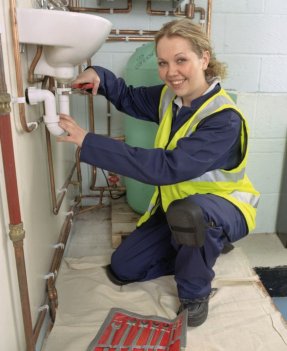
16. Hire Women Service Personnel


There are many arguments service company owners make to avoid hiring women for field positions…

Most women can’t lift a compressor.

I can’t send a woman into a bad neighborhood.

I can’t send dispatch a woman at night.

I can’t find women who want to work in the field.

Yada, yada, yada. The truth is there are times a woman service technician or plumber or electrician might need special accommodations. Those are obstacles, not barriers.

All of the reasons people give for NOT hiring a woman are trumped by the single most powerful reason FOR hiring a woman. Women sell more.

Women sell more because women are usually the decision makers for home service. Ask your call taker who phones in the most service requests, women or men. Ask your field service personnel who’s usually home on a service call, a woman or a man.

Women are service decision makers and women trust other women more than men. In focus groups, women and men both say they are less likely to believe a female mechanic will take advantage of them. While the empirical research is mixed about empathy differences between genders, women are more likely to relate well to other women. Relating better translates into selling more.

My personal experience from running a national franchise organization is women technicians generate higher customer satisfaction scores than men. This is consistent with Ron Smith’s experience at Modern Air Conditioning and Service America. It’s also been echoed dozens of times by contractors I’ve talked with in seminars and on the Service Roundtable.

An added advantage of hiring women for the field is distinction. Because field service is male dominated, women electricians, plumbers, and technicians stand out. Hire them and your company stands out.

Finally, if added sales, more satisfied customers, and more distinctive service are not reason enough to consider women for field service, hire them because there’s a shortage of skilled labor in the U.S., Canada, Australia, and the UK. We can’t whine about the shortage of skilled labor and continue to overlook slightly more than half the population.

(c) 2009 Matt Michel

Snakes on a Service Call

Field service personnel of all trades have plenty of stories about the unpleasant critters they encounter from time to time on service calls. Because this one includes some dramatic pictures, it's been circulated around the Internet.

Apparently, unpleasant and dangerous critters are such as problem in some states that utilities warn homeowners to be cautious when opening breaker boxes with open access holes. The pictures below, taken by an unknown utility linesman or electrician, illustrate what happens when a mouse scurries through a breaker box knockout hole, followed by a pursuing snake. If you look carefully in the final picture, you can see that the neither ultimately fared well.